Pope Francis said WHAT about St. Francis? Referencing whom?

I think this from # 66 of Laudato si says a lot about Pope Francis:

Saint Bonaventure held that, through universal reconciliation with every creature, Saint Francis in some way returned to the state of original innocence.[40]

In some way, eh? State of original innocence? That would be before Adam and Eve got the heave-ho from paradise.
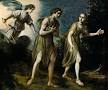
Adam, Eve expelled

Heave-ho

So maybe, in some way, the pope’s patron was cured of original sin, placing him second only to the Blessed Virgin Mary, who was conceived without it! Why haven’t we heard about this before Laudato si?

Because we have not been reading our St. Bonaventure, who floats this arresting speculation in The Major Legend of Saint Francis, VIII, 1, in Francis of Assisi: Early Documents, vol. 2, New York-London-Manila, 2000, 586 — which I know from reading Laudato si footnote 40 (of Francis’s 172).

The next sentence says more:

This is a far cry from our situation today, where sin is manifest in all its destructive power in wars, the various forms of violence and abuse, the abandonment of the most vulnerable, and attacks on nature.

Pope Francis is on firm, well-traveled ground here, except that what it’s a far cry from is the state of innocence granted to St. Francis because of his universal reconciliation with every creature, which we know because the early Franciscan Bonaventure mentioned it in his Life of the saint..

So Pope Francis bolsters his argument for saving the earth with a throwaway line from a 13th-century philosopher-theologian writing a book about the revered founder of his own religious order.

One foot in the 21st century as a prophet against man-made global warming, the other in the 13th as off-the-wall homilist. That’s our pope, too easily impressed.

Our modern Pope is stuck in ancient ways

Footnoted references in Pope Francis’s Laudato si range from Francis of Assisi’s Early Documents to Basil the Great — 172 in all, just two of them not a church source, one of these a noted 20th-century philosopher, the other a Muslim spiritual writer.

He offers no reference to any scientific authority or commentator, nothing but airy meditation material, bad poetry aimed primarily at the feelings, one a priori argument after another.

It’s a model of church talk, apodictic as can be. Why is he so apodictic? And formal? And so dependent on authority rather than argument made by his sources?

He concedes nothing. Nowhere is there a “coal does a lot of good, heating homes of many poor people, but . . . ” for instance. Nope, it’s “you have to shut up and listen,” it’s your holy father talking.

From the mountain top, or on one of the seven hills of his see city, he speaks. We are down below, being told what to do. He’s supreme, we are devotees.

But he’s actually from Argentina, and seems to think he knows how to help poor people because there are so many of them in his country. That’s no recommendation, for my Peter’s pence.

Maybe he should consider a country where there are not so many poor people, the United States, for instance, where tho on the rise it’s where every poor person in the world would give his eye teeth to live and where Mexican and other people are dying to get in.

Why not look to the one country where everyone wants to live and see how things are done there, one of the world’s most free-market capitalist countries?

Instead, he rails against free markets and pulls an Obama, making nice with dictators and other autocrats, he himself effectively dictating, under cover of biblical-style prophecy, how we should to run our countries and our lives. A little second-guessing of yourself, Holiness, a little humility!