Like milk? The whole near-creamy variety that brings a smile to your face? But you dasn’t drink it for health reasons? Consider this:
Whole milk is one of the best foods in the average corner shop-and a vital part of a nutritious diet for . . . children, . . . .
Whole milk is what is called a complete food, because each ingredient plays its part. Without the fat, you can’t digest the protein or absorb the calcium. The body needs saturated fat in particular (monounsaturated and polyunsaturated fat can’t do the job) to take in the calcium that makes bones strong. Milk fat also contains glycosphingolipids, which are fats that encourage cell metabolism and growth and fight gastrointestinal infections.
Vitamins?
The all-important vitamins A and D are found in the fat. Historically, whole milk and butter were the best sources of these vitamins in the American diet, which had up to 10 times more of both vitamins than modern industrial diets.
In skim and low-fat milk, the vitamins are removed along with the fat, so dairies add synthetic A and D. But Vitamins A and D are fat-soluble; that means they cannot be absorbed into the body unless they’re taken in with fat. Thus, even fortified skim and low-fat milk are not nearly as beneficial as the real thing.
Worried about your heart and arteries?
[S]cientists are increasingly finding that whole milk and saturated fats have been given an undeserved bad rap. Many experts say the evidence blaming saturated fats for heart disease is surprisingly weak. Indeed, the main effect of eating saturated fats is to raise high-density lipoproteins, or H.D.L., the so-called good cholesterol. And with H.D.L., the higher, the better.
Etc., from Nina Planck, author of Real Food: What to Eat and Why
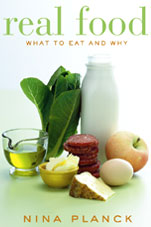
Who she?
[A] food writer, an advocate for traditional foods, an entrepreneur, and the leading American expert on farmers’ markets and local food. A champion of small farmers, she grew up on an ecological vegetable farm in Virginia and sold the family vegetables at farmers’ markets from age nine. After leaving the farm, Nina was a congressional staffer, a reporter for TIME, and a speechwriter for President Clinton’s ambassador to the UK.
A woman of parts, it appears.
 Blithe Spirit
I get e-mails from a Dr. Mercola, who has some good information regarding nutrition (and some wacky opinions on vaccinations and “Big Pharma”) and he maintains that we should drink whole, unpasturized milk because pasturization destroys some of the properties of whole milk. He is totally against , corn syrup (in most processed foods) and grains which he says increase not only the incidence of Type II diabetes but also heart attacks.
He says that meat products, like beef, are fine, if they are grass-fed, not corn fed.
Interesting that this information affirms Mercola’s research.
LikeLike
Oops, make that “he is totally against sugar, corn syrup) …
LikeLike
This study just goes to prove my longheld theory. If you don’t like the latest health report, don’t change diets; just change reports! There’s at least one of them out there to fit any food passion you feel….
LikeLike