The FBOP-FDIC-Mike Kelly debate, continued . . .

These comments in Wednesday Journal on the FBOP-Park National Bank closing at the hands of FDIC frame the argument nicely. 

First, a typical Oak Park response, echoed in dozens of comments in columns, editorials, and letters:

Posted: Thursday, November 19, 2009
Article comment by: Scott

We should be outraged that a community bank like FBOP was taken by the FDIC. Large institutions like Citi and Bank of America received millions of dollars in TARP money and what did they do? Spent most of it to pay our [for?] incentives or severence pay outs to CEOs and CFOs who were so greedy they left the institutions on near bankruptcy. Community Banks like FBOP who care about the communities and their employees were not able to receive any funding from the goverment.

If Mike Kelly was able to obtain money from private investors to put FBOP in a well capitalized state, then why didn’t the FDIC give them that opportunity? Instead they sold to US Bank who will in turn lay off employees and change a quality bank with great customer service and standards to something like Chase and Citi, who’s [sic] only concern is profit and loss. Not helping the communities they serve or the employees that work for them. It is tragic what they did to Mike Kelly and FBOP.

Then a cogent rebuttal:

Posted: Thursday, November 19, 2009
Article comment by: Stephen Micklin

Please excuse my apparent blindness, but I don’t see why everyone is so outraged about the FDIC’s takeover of FBOP Corp. Maybe I need to look at the facts through Oak Park tinted glasses, because with an objective eye the hoopla appears ludicrous and unreasonable. Let me highlight three aspects of the FBOP outrage that are, well, outrageous.

First, FBOP is to blame for its failure, not the FDIC or “Washington.” This obvious fact has someone been misconstrued. When the FDIC seized FBOP and arranged a deal with U.S. Bankcorp it was not acting with a vendetta against FBOP or favoring Wall Street over Main Street. The FDIC was doing its job—protecting depositors from losing all their money. FBOP fell into financial disarray because of misguided and greedy investments. Instead of keeping their money safe by buying Treasury Bills or other secure assets, FBOP decided to make a risky investment in Fannie Mae and Feddie Mac. FBOP wanted to squeeze out additional profits. Unfortunately those wagers backfired when the housing market collapsed. FBOP failed because it made bad investments. What is more, if not for the FDIC and U.S. Bankcorp’s actions, thousands of people could have lost their entire life savings.

Second, just because FBOP and Park National are now U.S. Bankcorp, it does not follow that neighborhood businesses and people will lose access to credit and banking facilities. If businesses and people are worthy of credit, other banks will step in to provide such loans. And if other banks refuse, then maybe those borrowers should never have received credit. Anyone would love a bank that extends credit on extremely favorable terms. Hey, subprime loans were a good idea for those receiving the funds. That does not mean, however, that such actions are sound banking practices. If Chicago and Oak park businesses and people are reliable borrowers then the absence of FBOP will not matter because other banks will rill FBOP’s shoes.

Third, people should not be angry that the FDIC had to spend $2.5 billion, they should be angry that FBOP forced them to spend the money. Had FBOP not made bad investments, the FDIC would not have had to use taxpayer money to protect customer’s deposits. Yet somehow the FDIC is being bashed. During a recent community meeting arranged to discuss FBOP’s failure (The protest gets formal), Oak Park Village President David Pope was quoted as saying “Two and a half billion dollars comes out to $25,000 for every man, woman and child in Austin. If you’re aware of the facts in this case and you’re not absolutely outraged, then you’re not alive.” I agree that the FDIC’s spending of $2.5 billion of taxpayer money is terrible, everyone should be. But we should be made at FBOP for forcing the FDIC to spend that money.

Maybe I am the only one in Oak Park with these views. Or maybe I am the only one looking at the facts without a hometown bias. Either way, the world will survive without FBOP Corp.

Not quite the only one.
Post-racial Cook County

I am shocked, shocked! to hear these ministers talking this way about the Cook County board president race.

A group of African-American ministers encouraged [Dorothy] Brown and [Toni] Preckwinkle to get out of the race because they say African-American votes will split up, allowing a white candidate to win.

They are the Concerned Clergy for a Blacker, I mean Better, Chicagoland.  Also Friends of Todd, which won’t sit well with Friends of Dorothy and Friends of Toni.

Studying Pilgrims and Indians

Very cautious Chi Trib story here, about second-graders at Beye School, Oak Park. 

The kids

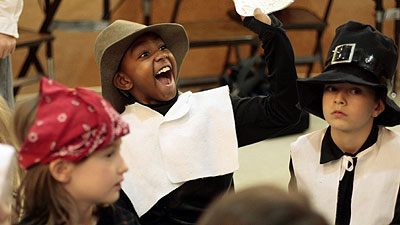
spent two school days aboard a faux Mayflower ship in their auditorium, braving simulated storms, seasickness and even the birth of a baby.

The pretend Pilgrims . . . kept journals to explore their fears of moving to a new land. . . . .

Beye kids 091125

Before the mock journey, they role-played and kept journals in a similar fashion as American Indians while studying different tribes.

The students also learned how some of the English settlers’ choices harmed indigenous people, examining both bright and tragic aspects of American history.

Many educators are striving to celebrate a more historically accurate Thanksgiving, ditching [sic] the stereotypical Pilgrim-and-Indian stories in favor of true [accurate?] social studies lessons. [Truly s.s. lessons, not faux ones?]

Teachers say a nuanced approach helps debunk popular myths and can add cultural awareness to the holiday. [Cliche hat trick there, dying for expansion and particularization]

“This makes history more real,” said Amber Schweigert, a second-grade teacher at Beye. [Italics added throughout]

Cautious because it tip-toes through minefields of cultural warfare, dropping hints.  The aim may have been to produce “a nice story,” as I heard a city editor speak approvingly many years ago and this writer may have heard a few days ago.  It ends up soft soap, tantalizing and deceptive.

Ron Grossman’s hard-copy, same-page [not web-site]companion piece produces something quite different.  It’s about

a number of Chicagoans who have discovered they are Pilgrim descendants and who gather on the weekend before Thanksgiving for a luncheon (yes, turkey). Someone reads the Mayflower Compact, a kind of mini-constitution the Pilgrims wrote just before landing at Plymouth Rock in 1620. Then the list of its signers is recited:

William Bradford, Myles Standish, John Alden

As each Pilgrim’s name is called out, his descendants rise.

The experience

“. . . sends shivers up the back of my neck, every time,” [Don] Sherman said. “Hearing the compact reminds me why it’s the first great historical document of our country.”

Grossman:

With only two sentences, the compact expressed a world-shaking idea: Ordinary people can govern themselves. In the 17th century, kings and nobles made the rules; others were to silently follow.

Not so among these settlers. A history lesson follows:

Originally called the Dissenters, [Pilgrims] were known and reviled for thinking outside the box, so to speak. [G. knows what he’s doing; semi-apologizes for radio-speak.]  They disliked what they considered the pompous Church of England and wanted to be ministered to by like-thinking preachers in simple churches. [Clean copy]

So the Dissenters went on a series of wanderings that would give them the name Pilgrims. They went first to what is now the Netherlands, even then an open-minded country. [A long-ago Dutch friend: French get ideas, Dutch have to try them.] Yet toleration presented another problem confronted by every immigrant group in whatever new homeland it chooses.

“Their children were becoming Dutch,” Morony said. “The Dissenters thought of themselves as English.”

They did not howl for bilingualism, whose day had not yet come, but like Huck Finn headed for the territory.

Fearing assimilation, a group of Dissenters planned a second exile: to a place far enough away from England that they could be free of the Church of England and yet still be English. Strangely, that agenda meshed with the thinking of London’s movers-and-shakers.

Late to colonizing, England wanted to catch up. So a scheme was hatched whereby the Pilgrims would be sent to New York as part of a commercial enterprise organized by English investors with the crown’s OK.

And off they went.  The rest is . . . [deleted as cliche] . . .