Author: Jim Bowman
Jim Bowman covered religion 1968-78 for the Chicago Daily News, since then has written books, articles, etc., mostly on corporate history but also on religion (Company Man: My Jesuit Life, 1950-1968), and more recently on politics (Illinois Blues: How the Ruling Party Talks to Voters -- Lulu.com, Kindle). Longtime Oak Park, Illinois, resident, he lives now on Chicago's North Side, where four of his and Winnie's six children live close by.
Strongman Barack Obama Goes Full Stalin: Tells Secret Court To Ignore Law He Signed 4 Hours Earlier, Extend Illegal NSA Surveillance
He has no sense of the rule of law. It’s all pragmatism with him. Utterly without principle. What works is good. Shades of the old black revolutionary “whatever means necessary. Whatever it takes.”
No morals in politics, said Lenin; only expediency. No vision except what’s in front of his nose. Small man.
Ends and means, according to Alinsky.
(Go News Alert.)
Pope Francis and Putin seeing eye to eye
We have the once-KGB top dog, now same for the once-USSR, really liking this pope who kept the relatively decent world out of Syria with one of his political forays, as explained in this fairly fatuous piece by once-NC Reporter man John Allen.
When will they ever change, when will they change?
And consider if you will the accompanying photo:
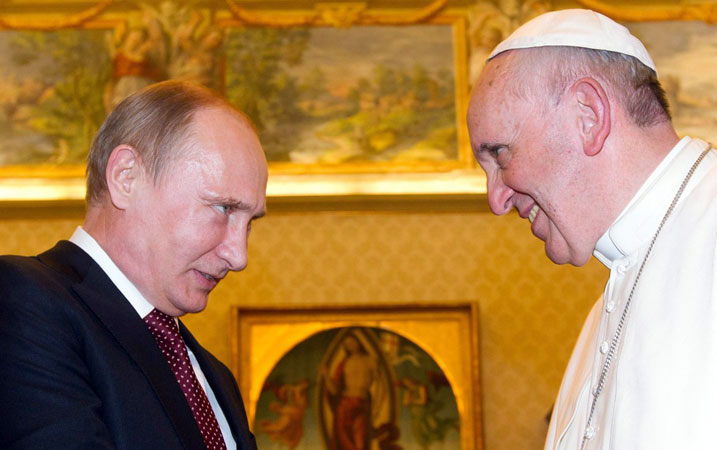
What gives with our pontiff, the way he LOVES those left-wing dictatorial types? What’s he thinking of?
Rauner’s the one, says Sun-Times
Having vowed to “shake [the state] up,” he is showing “what a shake-up looks like,” demanding “basic pro-business reforms before he will even talk about raising taxes. . . . Nobody should doubt he will continue to chop away if he and the Legislature’s Democratic leadership cannot find common ground.”
He will be “the bad guy” if necessary. “He clearly won’t settle for yet another politically expedient short-term fix.”
“He’s not kidding.” Not so the Democrats, says S-T, “especially House Speaker Michael Madigan.” Smart money will not go on him. “It doesn’t make sense,” when the bettor considers his 30 years at the helm (as House Speaker), of the last 32.
Problem? Unemployment 6 percent, vs. 5.4 percent nationally, “far higher” that the Midwest average. Population growth “stagnant.” The business climate “consistently ranked among the worst in the nation,” bond rating worst. The state’s awash in red ink — pension obligations “threaten to gut the entire government.”
Time for a change. Rauner is “all about change, which is why he was elected.” Madigan is “all about no change,” offering ” a yet “deeper hole.”
Rauner’s cuts “a scare tactic,” say Dems. “But it looks to us like a real plan.” Again, he’s not kidding, holds out possibility of cutting “much more.”
“Middle-Class Agenda,” Dems have responded, (typically) “long on crowd-pleasing gift-giving”: new tuition tax credit, higher minimum wage, free community college, and “guaranteed paid sick leave for all workers in the private sector, even those who work only part time”! (Santa Claus, we hardly knew you!)
Lovely, but how pay for it? (Classic Dem response to this question was by Congressman Danny Davis at Malcolm X College in August of 2009, as ObamaCare was being debated, “No matter the cost, quality health care should be provided for every citizen.”)
S-T: “Except for a call to close ‘corporate loopholes,’ nothing in the Democrats’ plan even hints at the sad truth that our state is broke.” Downplay the problem, Downplay the problem — like Sen. Don Harmon in a series of town hall sessions in the summer of 2013.
Which leads S-T to ask who is the real champion of the middle class” — the legislature that can’t say no or “a governor . . . who understands that Illinois is in desperate need of more fundamental reform?”
It wasn’t easy being an apostle. Ask Paul about his Corinthian friends
He could have written a column (a Corinthian column!) about it, instead wrote them another of his famous letters, 2nd Corinthians, which is “undoubtedly one of [his] most difficult,” says Mark A. Wauck in his intro to 2nd Corinthians found in his Letters of St. Paul(Pauline Books & Media, 1991),
It’s difficult not for any theological complexity, as in Paul to the Romans, but for its “intensely personal character and seeming lack of unity.”
Thing is, he was having a devil of a time with his converts in Corinth, whom he had recently left after two years of whipping them into shape. He writes now from Ephesus, a coastal city in what is now Turkey, an eight-day Aegean sea trip away, and Macedonia. (He’d left Corinth for a short trip to Palestine and Antioch, in Syria.)
He’d sent his man Titus to settle things in Corinth, where one troublemaker especially had to be disciplined…
View original post 47 more words
Rauner vs. Madigan in Illinois
Middle class, middle class, where art thou? Dems ask . . .
Chi Trib leads charge for Rauner . . .
. . in full throat, and to good effect.
Dear Gov. Rauner: You may be the last, best chance to protect Illinois’ future. . . . . The spring session has been Madigan and Cullerton’s time. Now it’s your time. You come across as a patient man who knows he was elected to govern for four years, not just the first five months. You also come across as a focused man. A governor who won’t flinch.
This must gall the hell out of Dems. In his town hall sessions in 2013, the heart of a book I am putting together about Blue Illinois as argued by Ruling Party minions, Sen. Don Harmon of Oak Park took early shots at the Trib as having “bashed the heart out of us.” . . . .
The Pope’s tongue gets forked when he requires so much explanation
John Allen predicts reaction to coming encyclical on the environment, starting with headlines saying Pope “backs strong limits on greenhouse gas emissions,” as if he “issued a political manifesto aligning himself with the Intergovernmental Panel on Climate Change, if not Greenpeace.”
That won’t be “entirely wrong,” says Allen.
Francis is indeed likely to accept the scientific consensus [sic] that global warming and climate change are real, and that human activity is the main cause. He’ll almost certainly call on nations to take strong action to address it. [Italics added]
Ah relevance, that will of the wisp that draws even supreme pontiffs into its orbit.
Question: Accepting this so-called consensus (consider the rascally deniers if you dare), will the Pope say why he accepts it? Will he invite discussion? (Heh: When do preachers invite discussion of anything?)
Will he become an important source for the global scientific community…
View original post 336 more words
Pope Francis’ heart is in right place, but he’s wrong about capitalism
What he should do is read a book by a fellow South American, Hernando de Soto, a Peruvian who came back from a long stay in Europe, saw how poor Peru is, and wondered why.
He might have knit his brow, come up with a theory, and set about to prove it. Instead, he “made an honest search for the truth with an experiment,” writes publicist and former White House speechwriter Mark W. Davis for U.S. News.
His experiment was to open a business in Lima without bribing anyone. It would be a small garment factory — two sewing machines — which he would register with a government agency as required.
Sure he would, after standing in line and filling out forms for 289 days. It’s how small businesses get started all over the have-not (developing) world — everywhere “a paper jungle.” Which makes it impossible, so they…
View original post 133 more words

