Illinois Blues: Pensioner’s “desperate look,” bond ratings, unemployment

At the Oak Park Library town hall, July 17, 2013 — from Illinois Blues: How the Ruling Party Talks to Voters, Chapter 3, “There Will Be No Cuts”:

A man asked why it had taken so long to do something about the pension issue when the Civic Federation of Chicago had raised the issue five years earlier.

Sen. Harmon played the therapist. He shared the questioner’s “frustration,” having seen the “desperate look” on the faces of people who fear losing pensions.

Nothing about why it had taken so long. Treating the do-nothing years as an act of God, himself as horrified observer. Not horrified, however, since even as he spoke, there was no crisis, he had said.

Another man complained that in response to Illinois’ lowest-in-nation bond rating and one of the nation’s highest unemployment rates, said citizens got nothing but “rhetoric.”

It was the first question about fiscal issues as such. The man stayed with his complaint, enlarging on it. Harmon listened up to a point, then called “next,” choosing not to engage him.

Rep. Lilly gloriously missed this and picked up with the persistent questioner, entering on extended commentary of her own, pacing back and forth, gesticulating, in general speaking as if to settle the question in an earnest, forceful, however cheery a manner.

The man threw in the towel, giving way to the next question, about a much-protested pawn shop on economically limping North Avenue and related matters.

Illinois Blues is available in paperbackepub and Amazon Kindle formats.

Property, income tax rates in Illinois

Sen. Harmon and Rep. Lilly continue their town hall meeting at Oak Park library, July 17, 2013 — from Illinois Blues: How the Ruling Party Talks to Voters, Chapter 3, “There Will Be No Cuts”:

The village clerk asked if property tax rates might rise. A “really, really good” question, Lilly said. She herself had asked it in a legislative committee meeting.

But really good question or not, she instead addressed the related but separate issue of allocating state funds for public schooling. “No way is education to be funded equitably across the state,” she said, meaning face-the-facts it won’t happen or over-my-dead-body it shouldn’t. Not clear.

But her “equitably” called up haves-vs.-have-nots funding of public schools — a sensitive issue for Oak Park homeowners. Harmon, an Oak Park homeowner, said he was “very sensitive” to the property-tax issue and let it go at that.

A man wondered if a “teeny tiny” income tax increase might be imposed. Harmon brought up (again) the Democrats’ “sixty-seven percent” increase (from 3 to 5%), signaling quote marks and adding, “We Democrats say two percent.” Challenged earlier, he was not quite ready to let that one go.

Again he ruled out service cuts. “We have already cut too much.”

Nonetheless, the state’s money shortage, said Lilly, was “really, really testing” the state’s financial capacities. Yes it was!

It’s about revenue, a man, said. “The rich should pay more.” He commended Harmon for a Wednesday Journal column in which he had put “crisis” in quotes. “Some are too rich” to need help from the government, the man added.

“Let ’em run for governor,” Harmon interjected, drawing laughter. Bruce Rauner had already announced, was to win the governorship sixteen months later.

Illinois Blues is available in paperbackepub and Amazon Kindle formats.

Tax trades, and say bye-bye to the Merc

Argument is simple enough: you would make trades unprofitable.

A proposal for Illinois to tax trades on exchanges in the state is “ridiculous,” according to the executive chairman of Chicago-based market operator CME Group Inc.

The suggested levy—which would charge $1 or $2 per contract, depending on the product—would make many transactions uneconomic, forcing the exchange to leave the state because customers would stop buying and selling, CME Chairman Terry Duffy said.

The bill, designed to increase revenue in the financially troubled state, is in early stages and faces long odds of approval.

Yes, as Sen. Don Harmon told an Oak Park audience in 2013, in this exchange from my Illinois Blues: How the Ruling Party Talks to Voters.

. . . from the floor came an enterprising suggestion, that even with Harmon’s proposed fair tax (“graduated”) there still wouldn’t be enough money. “So how about the proposed tax on stock trades?” (A “sales tax on speculators,” a columnist called it.)

[Rep. Camille Lilly] laughed. “Actually, I saw that proposal, among so many that I didn’t read.”

Harmon said he had heard testimony for this tax, naming a local socialist who was also an energetic proponent of a mandated “living wage” for village employees. But he gently poured cold water on the idea, Lilly next to him nodding vigorous agreement.

“There’s the fear that this legislation would push the Chicago Mercantile Exchange out of the state,” Harmon explained. It was a rare nod to the role of taxation in damaging the economy.

Illinois Blues is available also as paperback and non-Kindle ebook.

For the rest of the CME story: Newsalert: CME Boss says he would have no choice but to move CME if Illinois tax passes

The gentleman had questions for the lady . . .

Rep. Dwight Kay (R-Glen Carbon) questioning Democrat floor leader

. . . who had the WORST time answering.

Ladies and gentlemen, our tax dollars at work, as documented by a Republican rep and the ineffable Rep. Barbara Flynn Currie, ably assisted by a young woman who kept giving her tips as she responded, or sometimes had no tips to give, leading Rep. Currie to repeat “ditto” numerous times, all in response to the Republican’s asking if a budget line item had value for a “penniless” state.

Stay to the end or go there right away in this video of fecklessness by Democrats on full display. Over a million views and counting . . .

Source: (16) Illinois Policy

Cutting off Illinois water

Major lender says no more.

For years, Illinois has found the municipal-bond market open whenever it needs to raise money, despite budget deficits, worst-in-the-nation pension shortfalls and a political paralysis so severe it’s headed for a second year without even a blueprint for what it should be spending.

It’s about time to shut the doors on the state, says BlackRock Inc., the world’s largest money manager.

“We as municipal market participants should really be penalizing in some way, by almost not giving them any access to the market,” Peter Hayes, who oversees $119 billion as head of munis at BlackRock, said in New York on Wednesday. “Think about it — they’re a state without a budget, they refuse to pass a budget, they have the lowest funded ratio on their pension of any state, and yet they’re going to come to market and borrow money.”

This from someone who tries to handle other people’s money responsibly. Tries harder, we might say, than many if not most of Illinois’ elected officials.

Sen. Harmon of Oak Park an uber-loyal Democrat

It’s this Madigan budget. If party loyalty is Sen. Don Harmon’s (D-Oak Park) strong suit, as in his voting to short-change Oak Park schools, then it’s no surprise that he voted for the Madigan budget, with its absurd $7-billion deficit. On the minority side of a 17-31 vote, no less!

You dance with the one who brought you, of course. Harmon knows (and endorses) that. Where would he be without the party? So he went with the leadership, such as it is, and let the devil take the hindmost.

You can read more about Harmon, Rep. Camille Lilly, and others of the Ruling Party in my new book, Illinois Blues: How the Ruling Party Talks to Voters, available also in Kindle format.

Gov. Rauner vows to veto Madigan budget if it reaches his desk – Chicago Tribune

Budget that tries to reverse the state’s downward trajectory vs. one that kicks can down road:

Republican Gov. Bruce Rauner on Sunday vowed to veto a House Democratic state budget bill if it gets to his desk, setting up a potential election-year blame game against Speaker Michael Madigan should public schools throughout Illinois fail to open this fall.

Pension debt solution vs. same-old, same-old:

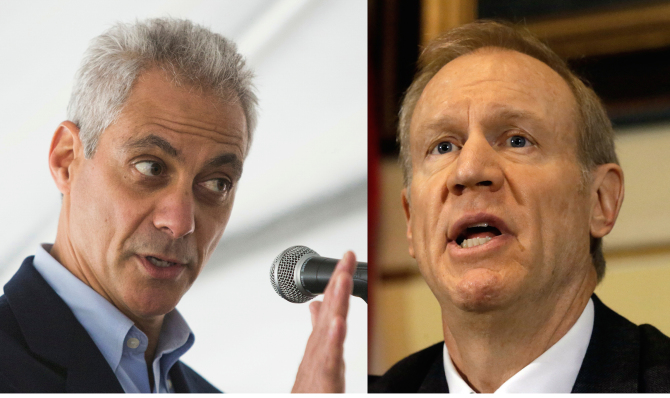
The threat came as Rauner and Mayor Rahm Emanuel ratcheted up their battle over the governor’s Friday veto of a bill that would have created a new funding timetable for Chicago police and fire pensions. Emanuel labeled a city property tax hike that now could be needed to fund pensions a “Rauner tax,” while the governor faulted the mayor for failing to come to Springfield to work for comprehensive reforms.

Businesses vs. unions and trial lawyers:

The spring session is scheduled to end at midnight Tuesday, but Madigan said Sunday that the House would remain in “continuous session” past the deadline — the same term he used at the end of May 2015 when the stalemate started — and disregarded Rauner’s call for a quick grand compromise that included elements of the governor’s pro-business agenda, parts of which would come at the expense of Democratic allies in organized labor and civil liability attorneys

Trouble is, businesses create jobs if given a chance, unions work to raise cost of doing business while taking care of their own, lawyers love high-payout cases in which they profit handsomely.

Guess who helps or hinders economic growth and prosperity.

Source: Gov. Rauner vows to veto Madigan budget if it reaches his desk – Chicago Tribune

Rahm has good idea of what do with a crisis, says Rauner doesn’t

Rahm is just mad because someone else believes in not letting a crisis go to waste.

The mayor said in a statement: “With a stroke of his pen, Bruce Rauner just told every Chicago taxpayer to take a hike.”

That said, about wasting a crisis, Rahm has a lot of nerve, getting indignant about this, he being a lover of the blue-state model, whose idea of a crisis is an opening for a new  fix-it program.

Tsk.

Source: Rahm says Rauner’s veto tells Chicago taxpayers to ‘take a hike’ | Chicago Sun-Times

State program throttled, senior citizen suffers. Illinois blues.

Thumbnail-sketch case study of standoff fallout:

The budget standoff hit home for Rachel Grainer when Illinois didn’t put up the money it promised seniors under its property tax-deferral program.

Fine. Of course, standoff doesn’t stand alone. It’s ridiculously inflated Democrat budget vs. Republican Gov. objecting to same. So I would like to see something futuristic that illustrates Illinois with budgets like this one.

Somewhere there’s a really smart columnist who can put future flesh and blood out there, online and on paper, to give us an idea of what the Republican governor finds objectionable. I ask you, is it too much to ask?

Source: BROWN: Oak Park woman faced tax hit on home over budget standoff | Chicago Sun-Times

Illinois Blues: How the Ruling Party Talks to Voters