Joseph Sobran Quote – Liberty Quotes Blog.
Greed in eyes of bolder.
The good and the bad, emphasis on Trib and Sun-Times
Joseph Sobran Quote – Liberty Quotes Blog.
Greed in eyes of bolder.
Warning, adult material. As found in a non-Firefox browser, not Firefox, where it is blocked by childish Firefox decision-makers, announcing their “hostility toward people who support preservation of traditional marriage in civil law.” Go to Firefox, which allows no copying of this message.
by Lisa Graas on May 24, 2014

Necessity, who is the mother of invention.
Plato, The Republic
Are you disgusted by homosexual acts? Then you are normal. The reaction of disgust to homosexuality is instinctive and natural. I bring this up again because of a story at The Daily Beast by a seemingly spurned and scornful Tim Teeman about Barbra Streisand becoming a disappointment to her “gay” fans because of her refusal to promote homosexual acts on the big screen in a movie entitled “The Normal Heart.” . . .
Etc. To…
View original post 27 more words
It’s too yucky for F-fox. (Which also refuses to be linked! Yikes!)
So go to Opera, one of four options it offers.
1. Is it good to take money from independent spenders so that government officials can spend it instead?
— room here for relevant Illinois data —
2. Do government officials, elected or otherwise, know what’s best for non-government people?
— room here for relevant Illinois data —
3. Is gvernment the principal engine of prosperity?
— room here for relevant Illinois data —
More such questions coming . . .
Rep. LaShawn Ford (Dem, IL-8) wanted Cicero Ave. to be renamed for Nelson Mandela from one end to the other. But the IL House cut the renamed portion to Roosevelt on one end, Grand Ave. on the other.
It’s going to cost $20,000, which Ford agreed “might seem like a really high price for new street signs.” But these signs will be special.
He wants “to make sure everyone who drives down that road knows it’s Mandela Road. . . . There will be a big sign or plaque at every stop light,” paying tribute to Mandela.
Ford, who the Trib noted “faces a federal bank fraud charge,” praised Mandela as “a great man who believed in forgiveness and coming together,” adding, “The district that I represent” — Western Springs, La Grange, La Grange Park, Brookfield, Forest Park, Proviso Township, Riverside, North Riverside, Berwyn, Oak Park, and Austin — “needs to see more hope.”
He envisioned the new Mandela Road as “as a symbol to my people that there is hope, and hope for change. That’s what Mandela stands for.”
The motion passed on a 103-0 vote and now heads to the Senate.
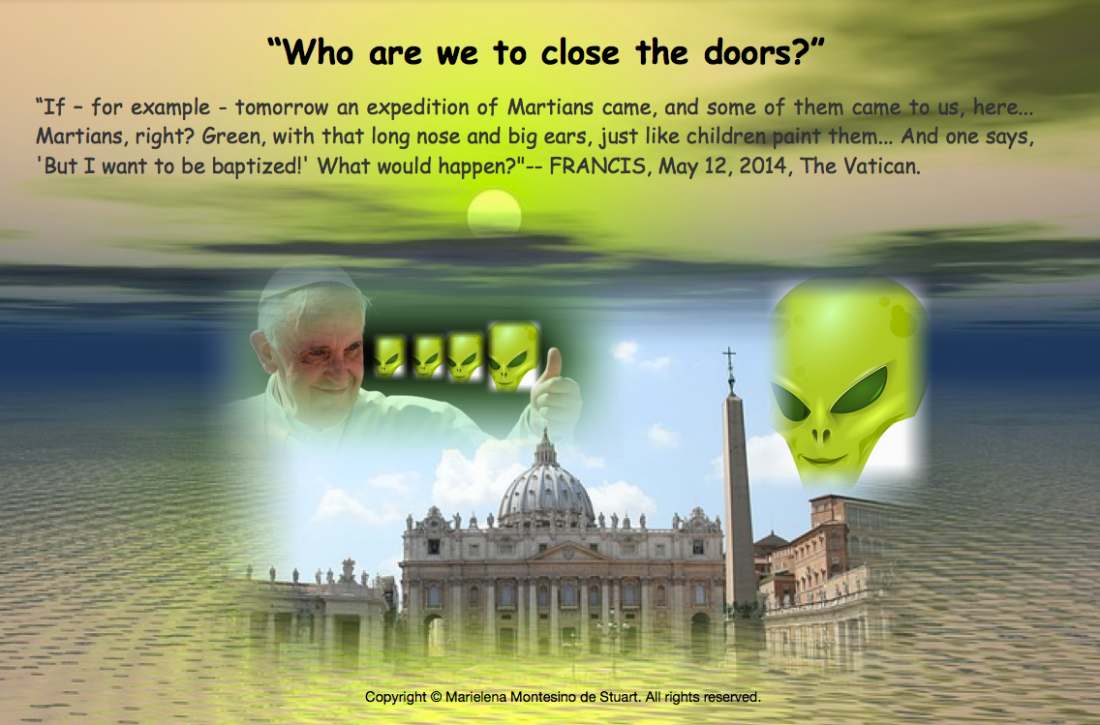
Marielena’s current list here. She’s on Pope Francis’ case . . .
Acton Institute’s Fr. Robert Sirico had words for Catholics about poor people May 9 at the monthly Catholic Citizens of Illinois meeting: Treat them like human beings first and objects of your philanthropy second. It was a rich exposition of Catholic social teaching before a lunchtime crowd of 70 at Chicago’s Union League Club.
He billed his talk, “How helping the poor can hurt,” admitting it’s “provocative.” In explanation, he noted that Acton’s “Poverty Cure,” a new DVD, warns against solutions to poverty that leave the poor worse off than before, treats them as “political chips,” for instance employing tariffs when “trade not aid” is the answer to problems faced by the poor.
One thing for sure he presented at the start: Catholics have an obligation to the poor, whether those poor in money or in spirit. No options are available. The poor must be served. There is no disagreement on this. It’s a matter of “Christian anthropology.” Catholic teaching is that caring for the poor is part of human nature. The only question is how to fulfill this obligation.
Remember that not everything the Pope says is infallible, he said — the Pope would agree with that, he added — including how to help the poor, about which opinions vary.
He recalled how as a seminarian at Catholic University, he helped out in a soup kitchen in the rough D.C. neighborhood of Anacostia. It was run by a Catholic nun in a Protestant church and was aggressively ecumenical, with dinners supplied weekly by women’s groups of various D.C. churches of all denominations. He and another seminarian picked the meals up and brought them to the church, served them, took out garbage and the like.
All were welcome to the meals, no questions asked. Sirico and his fellow seminarian one Friday went to a nearby fish and chips restaurant, the Protestant ladies having prepared a meat dish, which at that time was not permitted on a Friday. This is where he had his realization what was going on: the soup kitchen was competing with the fish and chips place, a mom-and-pop operation, without the overhead.
This wasn’t fair, he realized. The kitchen should be asking something of the recipients, as poor as most of them were, whatever they would choose to offer. Why presume they had nothing to offer? he asked himself. “Ask them to give a little,” he told his fellow seminarian, who had objected to Sirico’s objecting to the free-lunch concept.
He cited ancient Christian tradition, quoting the first-century handbook for new Christians, the Didache, which advised on how to help the poor. Christians were to seek a reciprocal relationship with each other and were not to eliminate the poor as people without ideas and other resources.
Theirs were to be a less romantic view of the poor, such as Sirico witnessed years ago when two young women of refined demeanor and careful grooming approached him about joining Mother Teresa to help the poor in India, which they had never visited. Recognizing the need for some instant education, a sort of shock treatment, he told them, “The poor stink, you know.” Later, lecturing in New Zealand, he told that story and next day read in a headline that he had said the poor stink — without reference to his giving an instant lesson to the two naifs.
The welfare state failure, he said Friday, is like that, in that it fails to consider the poor as people, administering “politicized charity” that flies in the face of his “Catholic anthropology,” with its emphasis on individual dignity and its requirement of “solidarity with people in need.”
The church sometimes offends in this regard. For instance the American bishops’ web site lists seven social-justice principles, including devotion to environmentalism, but not the principle of subsidiarity, which prescribes solving problems at the lowest society level possible, from family to national government. “Proximity matters,” Sirico said. It’s “a mistake to presume” in these matters that the higher levels — county over municipality, state over county, federal government over state, etc. — should be deployed as a matter of course.
Nor is the welfare system to be permanent. Referring to modern capitalism, Pope Francis has in mind crony and state capitalism, not free-market capitalism, Sirico said. As to tariffs, favored to protect a nation’s work forces from competition, he said they inhibit trade, which generates prosperity. Legislation to favor one constituency is not the free market at work.
Solidarity, a sense of responsibility for others including the poor, has equal standing with subsidiarity, a preference for the proximate and the smaller unit of government. The first is not a liberal trait, any more than subsidiarity is a conservative one. Together they comprise the Catholic approach.
Beware presumptions here about what works to drive down poverty. And ask yourselves what happened in the last 150 years to feed the billion starving in China? What was the instrument? Global markets, he answered, not welfare supports. Government’s role is to drop the barriers to people’s ability to get work.
This refutes the zero-sum game of the Marxist, the attempt to carve up a static prosperity pie, rather than make the pie grow. This zero-sum model he linked to the “anti-natalist movement,” the “huma-phobic” approach that sees population growth as the enemy, when as John Paul said, “Man’s greatest resource is man.”
The popes caution about seeking prosperity. Make no idol of money, they tell us. Rather, see prosperity as a tool of bettering the lot of many. Mother Teresa took on the whole Marxist paradigm, the Hegelian dialectic. Economic life, she said, is “not a warfare of the classes but an encounter” of each with the other, whereby the rich and poor save each other. This, he said, is Christian solidarity.
He took a moment at the end of his talk to note the passing of his “great friend,” University of Chicago economist and Nobel prize winner Gary Becker, who led in extending economics to human behavior, “including nonmarket behavior,” as his Nobel award put it and whose Nobel lecture was about “The Economic Way of Looking at Life.”
Answering questions, Sirico took note of economist Francis Hayek’s “fatal conceit” which leads politicians to think they know what’s best for others, including the millions making market decisions daily. He referred the need for “massive education” of priests and other church leaders in these matters. He cited Frederic Bastiat, who called the state a “great fiction” by which “everyone tries to live at the expense of everyone else.”
Asked about encyclicals for reading about social justice, he named John Paul II’s Centesimus Annus of 1991 and Leo XIII’s Rerum Novarum of 1891 as two basic sources, adding Veritatis Splendor for the nuances it offers of the mind of Pope Benedict.
Pressed by an objector to Pope Francis’s dismissal in his pastoral exhortation Evangelii Gaudium of “trickle-down economics,” he noted that Francis is neither socialist nor Marxist but a “Peronist populist.”
Asked about Catholic Charities’ 86% dependency on funding by the federal government in Chicago and the continued national collection for the Catholic Campaign for Human Development, he said that his parish in Grand Rapids does not take up that collection but substitutes a collection for a local initiative — arguing the application here of subsidiarity. Asked about (Saul) Alinskyism, he called it “dangerous.” One of his closing remarks was that he would “abolish” the Campaign if he could.
Ill. Courts Commission finally had a Brim-full and gave Judge Cynthia Brim the boot long after she set records for incompetence and erratic, in one case criminal, behavior. Read all about it in today’s Chi Trib. Story per Chi Trib
Congrats to the commission, doing its duty per the state constitution:
The Illinois Courts Commission, composed of one Supreme Court Justice, two Appellate Court Judges, two Circuit Judges and two citizens, has the authority . . . (1) to remove from office, . . . any member of the judiciary for willful misconduct in office, persistent failure to perform his or her duties or other conduct that is prejudicial to the administration of justice or that brings the judicial office into disrepute; or (2) to . . . retire any member of the judiciary who is physically or mentally unable to perform his or her duties
AND congrats to Oak Park’s stalwarts, elected senator and representatives Harmon, Lilly, and Ford for their valliant behind-scenes efforts to send Brim to the showers, no matter how much the Dem Party supported her and 56 other retention-ballot candidates, appearing “way down at the end of the ballot,” who had got thumbs-down assessments by the various bar associations.
Don’t ask how this blogger knows Harmon, Lilly, and Ford fought tooth and nail for withholding or at least softening the Toni Preckwinkle-led full-throated endorsements of these incompetents, robo-calls and all. He just knows. They are Oak Park’s finest, after all, upholding the village’s reputation for all that is noble and forthright and good-government-ish. Yay.
Last night at the library, Oak Park village president Anan Abu-Taleb said he sees “no light at the end of the [fiscal] tunnel” for Oak Park, except for the lights of an oncoming train. He had told of the 2012 audit of village finances that showed a miserable $145,000 cash balance, which he called the key signal to credit agencies of Oak Park’s dangerous situation.
A man in the audience of about 40 people gave chapter and verse on how a proposed zoning change would cut in half the value of a building which he intends to buy. Anan, supporting the change as putting unused land into play as revenue-generator, responded with reference to the not-in-my-back-yard syndrome as thwarting what’s best for the village.
He spoke at one of his patented town meetings, his fourth in a year, accompanied by a newly appointed trustee and the recently appointed executive pro-tem of the village’s recently created economic development mechanism — the man who a year ago opposed him in the electoral race for village board president.
Anan’s mark is on everything. He praised the former opponent, a longtime villager with decades of public service, as effective in this new role. With him to field questions was the young professional mother of two pre-schoolers whom he had picked to replace a longtime much-admired trustee who had moved for business reasons.
A woman warned of coming economic hard times for the village and country, sounding a fiscally accountable note that mirrored Anan’s. A man warned of coming hundred-degree days and asked what plans the village had if generators go down, interjecting high praise for Anan’s town meetings, in which the constant has been the fiscal issue.
Contrast this with Chicago’s Mayor Rahm Emanuel as depicted in
a stunning signed column by a member of the Chicago Tribune’s editorial board — “an arrogant person . . . an ass-kicker” whom we would celebrate if he got results.
“The strutting. The finger-pointing. The swearing. Come on. We loved it,” writes Kristen McQueary. But Rahm “his arrogance is oversized for the record he has amassed. He’s beyond bossy. He’s a walking personality disorder. . . . his audacity exceeds his accomplishments.”
His main failure is his continuance of Chicago mayors’ excessive borrowing to make ends meet. In his three years, “the city has only nipped and tucked at its debt and deficit spending.” In February, for instance, after nearly three years in office, he “pushed a $900 million borrowing plan through the Chicago City Council.”
It was a pattern for his predecessors. It’s a pattern for him, a reliance on “expensive taxable bonds with high interest rates.” The Trib’s 2013 series “Broken Bonds” spelled this out, McQueary wrote, “including an unexpected $12 million cost” to cover “the disastrous parking meter debacle,” a deal “that will end up costing taxpayers at least $30 million.”
He promised to fix the problem, and unions opposed him accordingly. But he’s become a problem. Which is a major difference between him and the Oak Park president, who made fiscal responsibility the foundation of his campaign and has followed through, doubling down on what he said then, as he did last night at the library.
 Blithe Spirit