Dem candidates at OP library: Stroger plus three

I’m a little late with this, but Nov. 14 is not that long ago, is it? That’s when Democrat candidates for county board president showed up at the Oak Park library, brought together by Dem Party of OP (DPOP). The Veterans Room on the second floor was filthy with Democrats, including assorted other candidates, with potential judges predominating.

But the stars were the incumbent, Todd (John-son) Stroger, who came late, and three challengers: Terry O’Brien, president of the Metropolitan Water Reclamation District (former Sanitary District, does sewage treatment for the Chicago area); 4th Ward (Hyde Park) Ald. Toni Preckwinkle; and Clerk of (county) Courts Dorothy Brown.

O’Brien made most sense. He would repeal the one-cent Stroger sales tax increase right away, all at once. It’s a tax-base destroyer in his book. Sales proceeds are down 14% in the year ending June 30, admittedly a bad year for sales. But businesses are decamping for neighboring counties. Reduce the tax rate, he argued implicitly, and you will increase tax revenue. Even in Cook County, liberal doctrine can be mugged by reality.

The other two challengers were not so sure. Preckwinkle would make “incremental cuts” while encouraging “economic development,” talking with “regional planning councils,” and starting “a jobs program.” Oh my, as if the market were waiting to be goosed by planners and programs.

Brown came out for “new ideas, not new taxes,” leaving cuts unmentioned — but not before winning the Oak Park Library declamation prize hands down. Rather, hands up, one holding the mike, the other moving continuously — circling, jabbing, flip-flopping, as if directing an invisible orchestra, eyes darting to and fro, face wrinkling, decibels multiplying.

She ended one segment, to scattered applause, with something about “the American dream.” Ending another, when the moderator called time, she hugged him. Later, when she announced her no-new-taxes (!) policy, she perorated, reaching crescendo with a memorable “If Barack Obama can be president, Dorothy Brown can be president of the county board!”

Preckwinkle was bland in comparison, businesslike, and direct enough. County hires, she said, come from “a few ward organizations, one of them the president’s [Stroger’s].” Jobs should be open to “the skilled” and spread around, especially to “Hispanics, [who] are underrepresented.”

Discussing the Forest Preserve district, O’Brien said he would consolidate it with the county. Brown would use “biometric technology” to monitor workers and would sell space for advertising on district property. Preckwinkle would rely on “professionalism,” keeping in mind that forest preserves are not just for recreation but are also “an ecological preserve.”

Forty-five minutes or so into the forum, Stroger arrived. “Had to stop at a funeral,” he explained. He said the board had “had a good three years” during his presidency, which would come as a surprise to many newspaper-readers. But it was “newspapers and television” that had decided he’s “a public enemy.” He had “found” a half-billion dollar deficit on entering office (slated to replace his stricken father on the ballot) and had worked it down to $238 billion, he said. To make up the shortfall, he had raised the sales tax.

He was glad he had done so. “You don’t hear complaints about services. We operate efficiently.” As for cutting taxes, “you have to be responsible,” he said. “You need money to do things.”

To a question about how the board might operate more effectively, Preckwinkle said she would bring “a new tone,” persuading commissioners to be “respectful of each other” and not engage in “hurtful personal interaction.”

“You lead by talking to people,” said O’Brien. “You must reach out to other elected officials.” Brown echoed that, saying they should pay more attention to “Springfield.”

Stroger portrayed opponents as “playing to the camera,” which he said “has become a way of life” for them. He said he had asked intended tax-cutters to show how they would avoid cutting services, but they had no answer. “We can take no money away” from services, he said, especially health system services.

Opposition to his leadership was “all posturing,” he said, but added, “We get along very well.” Again, the problems were caused by “the press.”

In the matter of spending and bidding on contracts, O’Brien said he was “shocked” to learn that expenditures of “up to $100,000” did not require board approval. But Stroger denied it. The limit was $25,000, he said. “All is done through requests for proposal,” he said. “We run things in a very professional way.”

O’Brien said there should be one procurement department for all of county government. He would do audits of every department, streamlining and consolidating as was done at the triple-A bond-rated Water Reclamation District, which last year returned $56 million to taxpayers. The district had 3,000 employees in 1988, when O’Brien became a commissioner; now it has 2,000, the reduction gained entirely by attrition, he said.

Preckwinkle blamed the patronage problem on the absence of public financing of elections. [No: see comment from her campaign below] She would take no money from county employees, she said: It “smacks of coercion.”

Stroger repeated his emphasis on non-interruption of services: “You’re going to hear a lot of things,” he said. “But nobody is saying they are not getting what they need.”
First, burn it, then, stupid, keep it simple

The House and Senate health care bills give us

an overregulated, overbureaucratized system of surpassing arbitrariness and inefficiency. Throw a dart at the Senate tome:

–You’ll find mandates with financial penalties — the amounts picked out of a hat.

–You’ll find insurance companies (who live and die by their actuarial skills) told exactly what weight to give risk factors, such as age.

Currently insurance premiums for 20-somethings are about one-sixth the premiums for 60-somethings. The House bill dictates the young shall now pay at minimum one-half; the Senate bill, one-third — numbers picked out of a hat.

–You’ll find sliding scales for health-insurance subsidies — percentages picked out of a hat — that will radically raise marginal income tax rates for middle-class recipients, among other crazy unintended consequences.

Charles Krauthammer has a solution:

The bill . . . should not only be defeated. It should be immolated, its ashes scattered over the Senate swimming pool.

Then do health care the right way — one reform at a time, each simple and simplifying, aimed at reducing complexity, arbitrariness and inefficiency.

Which means zero in on tort reform, interstate buying and selling of health insurance, and taxation of employer-provided health insurance.

Trial lawyers don’t like the one, the left doesn’t like the other, which obviates need for public option, and unions don’t like the last

The lawyers are big-bucks people who give heavily to Dems, the left we have always with us, unions love big government, by whom most of their members are employed.

“Insuring the uninsured is a moral imperative,” says K. in today’s Chi Trib.

The problem is that the Democrats have chosen the worst possible method — a $1 trillion new entitlement of stupefying arbitrariness and inefficiency.

Better to “attack . . . inefficiencies . . . one by one — tort reform, interstate purchasing and taxing employee benefits.”

A bill that did that would be shorter — 20 not 2,000 pages — and pay for insurance for the uninsured “without wrecking both U.S. health care and the U.S. Treasury.”

And don’t get him started on the economic recklessness part.

The FBOP-FDIC-Mike Kelly debate, continued . . .

These comments in Wednesday Journal on the FBOP-Park National Bank closing at the hands of FDIC frame the argument nicely. 

First, a typical Oak Park response, echoed in dozens of comments in columns, editorials, and letters:

Posted: Thursday, November 19, 2009
Article comment by: Scott

We should be outraged that a community bank like FBOP was taken by the FDIC. Large institutions like Citi and Bank of America received millions of dollars in TARP money and what did they do? Spent most of it to pay our [for?] incentives or severence pay outs to CEOs and CFOs who were so greedy they left the institutions on near bankruptcy. Community Banks like FBOP who care about the communities and their employees were not able to receive any funding from the goverment.

If Mike Kelly was able to obtain money from private investors to put FBOP in a well capitalized state, then why didn’t the FDIC give them that opportunity? Instead they sold to US Bank who will in turn lay off employees and change a quality bank with great customer service and standards to something like Chase and Citi, who’s [sic] only concern is profit and loss. Not helping the communities they serve or the employees that work for them. It is tragic what they did to Mike Kelly and FBOP.

Then a cogent rebuttal:

Posted: Thursday, November 19, 2009
Article comment by: Stephen Micklin

Please excuse my apparent blindness, but I don’t see why everyone is so outraged about the FDIC’s takeover of FBOP Corp. Maybe I need to look at the facts through Oak Park tinted glasses, because with an objective eye the hoopla appears ludicrous and unreasonable. Let me highlight three aspects of the FBOP outrage that are, well, outrageous.

First, FBOP is to blame for its failure, not the FDIC or “Washington.” This obvious fact has someone been misconstrued. When the FDIC seized FBOP and arranged a deal with U.S. Bankcorp it was not acting with a vendetta against FBOP or favoring Wall Street over Main Street. The FDIC was doing its job—protecting depositors from losing all their money. FBOP fell into financial disarray because of misguided and greedy investments. Instead of keeping their money safe by buying Treasury Bills or other secure assets, FBOP decided to make a risky investment in Fannie Mae and Feddie Mac. FBOP wanted to squeeze out additional profits. Unfortunately those wagers backfired when the housing market collapsed. FBOP failed because it made bad investments. What is more, if not for the FDIC and U.S. Bankcorp’s actions, thousands of people could have lost their entire life savings.

Second, just because FBOP and Park National are now U.S. Bankcorp, it does not follow that neighborhood businesses and people will lose access to credit and banking facilities. If businesses and people are worthy of credit, other banks will step in to provide such loans. And if other banks refuse, then maybe those borrowers should never have received credit. Anyone would love a bank that extends credit on extremely favorable terms. Hey, subprime loans were a good idea for those receiving the funds. That does not mean, however, that such actions are sound banking practices. If Chicago and Oak park businesses and people are reliable borrowers then the absence of FBOP will not matter because other banks will rill FBOP’s shoes.

Third, people should not be angry that the FDIC had to spend $2.5 billion, they should be angry that FBOP forced them to spend the money. Had FBOP not made bad investments, the FDIC would not have had to use taxpayer money to protect customer’s deposits. Yet somehow the FDIC is being bashed. During a recent community meeting arranged to discuss FBOP’s failure (The protest gets formal), Oak Park Village President David Pope was quoted as saying “Two and a half billion dollars comes out to $25,000 for every man, woman and child in Austin. If you’re aware of the facts in this case and you’re not absolutely outraged, then you’re not alive.” I agree that the FDIC’s spending of $2.5 billion of taxpayer money is terrible, everyone should be. But we should be made at FBOP for forcing the FDIC to spend that money.

Maybe I am the only one in Oak Park with these views. Or maybe I am the only one looking at the facts without a hometown bias. Either way, the world will survive without FBOP Corp.

Not quite the only one.

Post-racial Cook County

I am shocked, shocked! to hear these ministers talking this way about the Cook County board president race.

A group of African-American ministers encouraged [Dorothy] Brown and [Toni] Preckwinkle to get out of the race because they say African-American votes will split up, allowing a white candidate to win.

They are the Concerned Clergy for a Blacker, I mean Better, Chicagoland.  Also Friends of Todd, which won’t sit well with Friends of Dorothy and Friends of Toni.

Studying Pilgrims and Indians

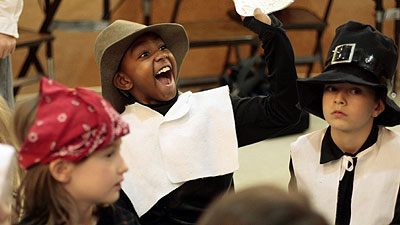
Very cautious Chi Trib story here, about second-graders at Beye School, Oak Park. 

The kids

spent two school days aboard a faux Mayflower ship in their auditorium, braving simulated storms, seasickness and even the birth of a baby.

The pretend Pilgrims . . . kept journals to explore their fears of moving to a new land. . . . .

Beye kids 091125

Before the mock journey, they role-played and kept journals in a similar fashion as American Indians while studying different tribes.

The students also learned how some of the English settlers’ choices harmed indigenous people, examining both bright and tragic aspects of American history.

Many educators are striving to celebrate a more historically accurate Thanksgiving, ditching [sic] the stereotypical Pilgrim-and-Indian stories in favor of true [accurate?] social studies lessons. [Truly s.s. lessons, not faux ones?]

Teachers say a nuanced approach helps debunk popular myths and can add cultural awareness to the holiday. [Cliche hat trick there, dying for expansion and particularization]

“This makes history more real,” said Amber Schweigert, a second-grade teacher at Beye. [Italics added throughout]

Cautious because it tip-toes through minefields of cultural warfare, dropping hints.  The aim may have been to produce “a nice story,” as I heard a city editor speak approvingly many years ago and this writer may have heard a few days ago.  It ends up soft soap, tantalizing and deceptive.

Ron Grossman’s hard-copy, same-page [not web-site]companion piece produces something quite different.  It’s about

a number of Chicagoans who have discovered they are Pilgrim descendants and who gather on the weekend before Thanksgiving for a luncheon (yes, turkey). Someone reads the Mayflower Compact, a kind of mini-constitution the Pilgrims wrote just before landing at Plymouth Rock in 1620. Then the list of its signers is recited:

William Bradford, Myles Standish, John Alden

As each Pilgrim’s name is called out, his descendants rise.

The experience

“. . . sends shivers up the back of my neck, every time,” [Don] Sherman said. “Hearing the compact reminds me why it’s the first great historical document of our country.”

Grossman:

With only two sentences, the compact expressed a world-shaking idea: Ordinary people can govern themselves. In the 17th century, kings and nobles made the rules; others were to silently follow.

Not so among these settlers. A history lesson follows:

Originally called the Dissenters, [Pilgrims] were known and reviled for thinking outside the box, so to speak. [G. knows what he’s doing; semi-apologizes for radio-speak.]  They disliked what they considered the pompous Church of England and wanted to be ministered to by like-thinking preachers in simple churches. [Clean copy]

So the Dissenters went on a series of wanderings that would give them the name Pilgrims. They went first to what is now the Netherlands, even then an open-minded country. [A long-ago Dutch friend: French get ideas, Dutch have to try them.] Yet toleration presented another problem confronted by every immigrant group in whatever new homeland it chooses.

“Their children were becoming Dutch,” Morony said. “The Dissenters thought of themselves as English.”

They did not howl for bilingualism, whose day had not yet come, but like Huck Finn headed for the territory.

Fearing assimilation, a group of Dissenters planned a second exile: to a place far enough away from England that they could be free of the Church of England and yet still be English. Strangely, that agenda meshed with the thinking of London’s movers-and-shakers.

Late to colonizing, England wanted to catch up. So a scheme was hatched whereby the Pilgrims would be sent to New York as part of a commercial enterprise organized by English investors with the crown’s OK.

And off they went.  The rest is . . . [deleted as cliche] . . .

Tale of two delays

Yesterday’s Antietam is today’s Afghanistan?  Consider

General George B. McClellan, whose willingness to delay action and refusal to do so allowed enemy forces to prepare and react.

The delay was leading up to what became “the bloodiest battle of the Civil War, in fact, the single bloodiest day in American military history,” writes J.P. Freire, Wash. Examiner associate commentary editor.

It was McClellan’s “willingness to delay action [that] allowed enemy forces to prepare and react.”

Of him, Confederate Gen. Robert E. Lee said:

“He is an able general but a very cautious one. His army is in a very demoralized and chaotic condition, and will not be prepared for offensive operations—or he will not think it so—for three or four weeks.”

Freire:

General [Gen. Stanley A.] McChrystal told the president that the war could be lost in a year, and three months of that year have been given to the enemy to regroup and prepare. . . .  If you have a general who is competent, as McChrystal is, give him what he says he needs to win.

Or if you consider him incompetent, fire him, as Lincoln did McClellan.  Do it or get off the pot.

ACORN and its Catholic donations

The latest from ACORN:

Shockingly, we now learn that the ACORN office in National City (San Diego County) engaged in a massive document dump on the evening of October 9th, containing thousands upon thousands of sensitive documents, just days prior to the Attorney General’s visit.

SanDiegoACORNDocumentDumpScandal-100909-Photo4

BigGovernment.com has learned that not only did this document dump occur, but the documents in question were irresponsibly and brazenly dumped in a public dumpster, without considering laws and regulations as to how sensitive information should be treated.

Would the Catholic Campaign for Human Development know if this is the same ACORN that until a year ago got Catholic donations?  I think it is.

FDIC-FBOP-GEITHNER-GOOF-etc.

Remember the odd thing about Park National Bank’s demise?  How on the fateful day, it got money from Treasury for poor neighborhoods?  Well, FDIC, which supervised the demise, blames T-Sec Geithner for the gaffe-goof, as reported by The Street-dot-com on 11/1, two days after the seizure:

The Treasury Department, not the Federal Deposit Insurance Corp., should be held responsible for a public relations gaffe last month in which the FDIC closed a Chicago bank just hours after it received an award from Treasury Secretary Tim Geithner, according to FDIC spokesman David Barr.

The grim details:

Park National Bank of Chicago received $50 million in tax credits to encourage investment in poor communities at an Oct. 30 ceremony attended by Geithner. Hours later . . . it was seized along with eight other banks around the country that formed part of a holding company called FBOP Corp. and sold to U.S. Bancorp.

However:

One financial services executive, who did not want to be on the record for fear of running afoul of regulators, accused the FDIC of timing the closure as it did in a deliberate effort to embarrass Geithner.

Among a dozen or so comments disputing or accepting this claim is a call by CNBC’s Jim Cramer for FDIC head Sheila Bair’s ouster as “as a rogue operator who cannot be reined in,” to which came a rejoinder by commenter CedricT:

Not really—it just shows how poorly managed and co-oordinated our Government is—these turf wars are their life blood. . . .  Looks like the same happened in Ft Hood–the FBI knew about the mad Major but neglected to tell the Army—and these are the guys who are going to “Fix” the Healthcare system–God Help us!!

Normally, I say leave God out of it, but this time prayer seems appropriate.

Finally, the article itself ends with this about what the hell happened to FBOP:

Though Park National was relatively healthy, it was shuttered because it could not cover the losses of other banks in the FBOP holding company.

Yes, we understood that, especially in Oak Park, which may never recover from the shock of it all. 

Then too, the buying into governmentally approved and supervised (?!) operations:

In addition to the usual real estate loans gone bad that have dogged virtually every institution from Bank of America . . . to Goldman Sachs . . . the FBOP banks had big losses on preferred shares of Fannie Mae . . . and Freddie Mac . . . according to a report in the Wall Street Journal [here] . . .

How WSJ characterized FBOP owner Mike Kelly:

The nine small banks represented the holdings of FBOP Corp., based in Oak Park, Ill., and owned by a banker who had plowed into real-estate lending around the country. [italics added]

Cost to FDIC: $2.5 billion.

A (non-Oak Park) banker put it to me this way: FDIC was cutting its losses by moving when it did, forestalling FBOP’s cutting loose its troubled banks (assets) and leaving FDIC with something unsalable.  Better for taxpayers, the argument goes, to have the whole bunch of them and making a sale — in this case to U.S. Bank.

Total number of failed banks this year: 115, the most since 1992, when 181 banks collapsed during the savings-and-loan crisis — which is when Kelly began to expand his holdings, buying banks outside Chicago that proved his undoing.

The content of their character

This from the redoubtable Heather Mac Donald in City Journal tells us what “even playing field” means to some people — equal results, across the board:

As part of its plan to comply with a federal desegregation order now decades old, Tucson’s school district adopted racial quotas in school discipline this summer.

Schools that suspend or expel Hispanic and black students at higher rates than white students will now get a visit from a district “Equity Team” and will be expected to remedy those disparities by reducing their minority discipline rates.

In Oak Park discipline rates are regularly discussed with a view to disparity of punishment.  Objectors to how more often blacks are punished even brought in elected officials from outside Oak Park.  But nothing like this has happened.  No one has called from a quota that I know of.

As for the language abuse embodied in that “playing field” stuff, it’s been lambasted best by George Orwell in his “Politics and the English Language,” in which he notes the role of language in stultifying our processes:

[Our language] becomes ugly and inaccurate because our thoughts are foolish, but the slovenliness of our language makes it easier for us to have foolish thoughts.

The ebullient, even bombastic Ezra Pound was even more condemnatory in “A Problem of (Specifically) Style” in 1934:

[A] tolerance for slipshod expression in whatever department of writing gradually leads to chaos . . . and a progressive rottenness of spirit.

In Tucson the pattern seems clear enough:

Tucson’s administrators explain their disciplinary quota pressure on the ground that students removed from class lose valuable learning time, exacerbating the already great ethnic academic achievement gap.

Such thinking ignores the students who are not disrupting class or threatening teachers and who also lose valuable learning time when unruly or violent students remain in the classroom.

Mac Donald adds:

Surely those students have a greater claim to “equity” in school resources than gang members do.

Schools are to look for “root causes” in bad behavior.  Mac Donald:

I can save them some time: the root cause of disparate rates of suspension is disparate rates of bad behavior.

“Single parenting” is the biggest one.

If the Tucson school board wants to publicize the essential role of fathers in raising law-abiding children, it might start solving the problem of disciplinary imbalance.

But until then, it should let schools resolve their discipline problems in a color-blind fashion, without worrying about a visit from an “Equity Team.”

It’s “the content of their character,” as Martin Luther King said in his “I have a dream” speech.

Rev. Jesse Jackson wants no part of that.  He calls invoking King in this context is “intellectual terrorism.”  Orwellian, right?

Prominent Wheeling Jesuit alum slams Giulietti firing

A contributor and volunteer fund-raiser for Wheeling Jesuit University has withdrawn his promised support amounting to $650,000 in cash and property bequests in protest of the firing in August of Rev. Julio Giulietti, SJ, as president.

The firing was “the most cowardly, deceitful and morally perverse action that I have ever witnessed,” said Stephen E. Haid in an Oct. 18 letter to interim President J. Davitt McAteer.  Blithe Spirit has obtained a copy of the letter.

Haid, a 1963 graduate of Wheeling Jesuit and longtime teacher at West Virginia University until becoming a teachers union lobbyist and then campaign chairman and later cabinet member in Gov. Gaston Caperton’s administration, blames the firing on three people or groups:

* Bishop Michael Bransfield of Wheeling, who “wanted to slap [Giulietti] down” because Giulietti “sought to acquire the [adjacent] Mount de Chantal property for Wheeling Jesuit.”

* “An element on the Board of Directors . . . who want to micromanage the University, who want any president to be an errand boy.”

* The three Jesuit trustees who “in an irregular night session” voted to fire Giulietti.

Haid was named last March by Giulietti as one of two Special Assistants to the President for Advancement to work on planned giving, endowment development and alumni partnerships, with an office on campus.

It was a continuation of his working “very closely” with Giulietti “for at least a year,” he said in his letter.

Among Haid’s other activities is to serve with Bishop Bransfield on the board of the West Virginia KIDS COUNT Fund, founded in 1989 by Gov. Caperton, who later became president of The College Board.

Haid has also served on the board of governors of Marshall University, in Huntington, WV — at one time as a member of its executive committee.