Leopard’s spots

Bill McGurn in Wall Street Journal considers how Obama can save his presidency, mired now in health care legislation, as Clinton was mired in health care legislation.  Avoid Clinton’s “mistakes,” say Obama-ites.  McGurn calls that “not a winning strategy.”

A far more productive strategy would be to embrace Mr. Clinton’s success, which was freeing himself from his party’s left and returning to the centrist themes he had campaigned on.

But would that not be to surrender the raison d’etre of his political career?  If he has to continue the campaign charade in deed as well as word, what’s the point of it all?

Belated sighting of elephant in room

Now and then an obvious truth is restated:

The budget shortfall for 2010 would mark the second straight year of trillion-dollar deficits. Along with the unemployment numbers, the deficit may complicate President Barack Obama’s drive for his top domestic priority, overhauling the U.S. health care system.

“It throws a wrench in health-care reforms,” Maya MacGuineas, president of the bipartisan Committee for a Responsible Federal Budget, said in an interview. “No matter the specific numbers, they’re a constant reminder that we’re in bad, bad shape.

And a Republican goes further:

“If anyone had any doubts that this burden on future generations is unsustainable, they’re gone,” said Senate Republican leader Mitch McConnell, adding that economic stimulus funds should be diverted to pay down U.S. debt.

Oh that golden stimulus, oh that golden stimulus.  Liquidate that!

Oak Park walker reports from Sin City

Gina from Vegas looks back in delight at Oak Park IL, where she used to live, in a comment in this CNN Money article about “walkability” in city neighborhoods:

I live in Las Vegas . . . [where] efforts to bring walkability to insulated planned communities has primarily been shut down by the economy, though my last neighborhood was close, with two parks, a library, some shopping, and restaurants all within a few miles. It was also in a new (built around 2002) upper-class master planned community. It still didnt hold a candle to my old neighborhood in Oak Park, IL outside of Chicago. I frequently went months without seeing my car when I lived there.

She has that right.

Planning since Daniel Burnham

I helped with this book, in editing and research. It’s

“Beyond Burnham: An Illustrated History of Planning for the Chicago Region,” [in which] authors Joseph Schwieterman and Alan Mammoser trace the fits and starts of regional planning since 1909, giving overdue credit to the brave souls who dared swim against the prevailing tides of profit and parochialism.

It brings “brutal honesty” to the material, says op-ed reviewer John McCarron in today’s Chi Trib.

“Beyond Burnham” all but admits that regional planning since Burnham has been, with a few key exceptions, a lost cause. When World War II ended and pent-up demand for housing burst upon the land, those who favored a more orderly pattern of development — one that would have preserved open space and clustered new homes and stores closer to commuter rail corridors — were easily brushed aside.

For many reasons, it was not easy to sell metropolitan planning:

Today’s raucous “town hall” meetings on health-care reform may seem unprecedented, until one reads about public hearings in the 1960s where reps of the Northeastern Illinois Planning Commission got told a thing or two by Adeline Dropka and the Save Our Suburbs coalition.

While chronicling this history of political conflict, the book also offers “a trove of regional trivia.”

Who knew that the first suburbs to cash in on federal transportation funds were conservative Winnetka and Glencoe? They clouted $1.5 million in 1938 to lower the North Western (now Metra/Union Pacific) railway tracks and eliminate 10 grade crossings.

It’s due out tomorrow from Lake Forest College Press. Amazon has it as a “pre-order” for $13.57.

Holy mother the state will decide

How would a monster put this?

Ezekiel Emanuel, Rahm Emanuel’s brother and one of Obama’s health-care advisors, wrote in a January 2009 white paper that health care should be rationed in a way that “promot[es] and reward[s] social usefulness.” He said age could play a factor in determining who can and cannot access health-care resources.

What’s more:

Emanuel also wrote, “[S]ervices provided to individuals who are irreversibly prevented from being or becoming participating citizens [in the body politic] are not basic and should not be guaranteed. An obvious example is not guaranteeing health services to patients with dementia.”

And the maximum leader?

Obama addressed this too, saying, “Whether, sort of in the aggregate, society making those decisions to give my grandmother, or everybody else’s aging grandparents or parents, a hip replacement when they’re terminally ill is a sustainable model, is a very difficult question. … And that’s part of why you have to have some independent group that can give you guidance.”

Did someone say “death panel”?

It’s a brave, brave, brave new world we are looking at.

In Salon, Camille Paglia makes much the same point, praising Sarah Palin for her “shrewdly timed metaphor,” which “spoke directly to the electorate’s unease with the prospect of shadowy, unelected government figures controlling our lives. A death panel not only has the power of life and death but is itself a symptom of a Kafkaesque brave new world where authority has become remote, arbitrary and spectral.”

As for sharp views of both Salon —

“a pretentious word for a beer and wine guzzle and gum flap”

— and Paglia —

“openly gay yet not given to strident agenda netting . . . a former Catholic who respects the beauty, mystery and majesty of the Faith . . . a feminist who never allows simple-minded association to grab for the broad brush and repaint the house”

— see the well-stocked mind and intellectual pointillism of Pat Hickey, who supplies a dated but fetching image for the former:

abraham bosse salon de dames

Sen. Rockefeller puts it clearly enough:

Sen. Jay Rockefeller, D-W. Va., said in March that as part of responsible healthcare reform people must recognize they would not be able to get every treatment they wanted. The government would use a cost-benefit analysis to determine treatment options.

The government, yes.

Erick Erickson sums it up:

It is an inevitable fact of life that the more the government outlays to keep you alive, the more your life becomes subject to a cost/benefit analysis.

That would be Holy Mother.

One foot in grave, the other in Boston

This guy says if Ted Kennedy is so worried about Massachusetts’ having two senate voices, he should resign. Add this: At what point does he get ready to die and give up politics. It’s like the Tex Williams song about the smoker:

Tell St. Peter at the Golden Gate
That you hate to make him wait,
But you just gotta have another cigarette.

Come on, Ted, enough of twisting arms and cajoling voters. St. Peter waits for no senate vote.

Down and down he goes . . .

Zowie. His lowest rating yet.

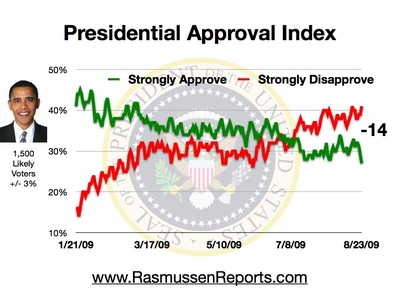
The Rasmussen Reports daily Presidential Tracking Poll for Sunday shows that 27% of the nation’s voters Strongly Approve of the way that Barack Obama is performing his role as President. Forty-one percent (41%) Strongly Disapprove giving Obama a Presidential Approval Index rating of -14. These figures mark the lowest Approval Index rating yet recorded for this President. The previous low of -12 was reached on July 30 (see trends).

It’s the first time “strongly approve” went below 29%. Not quite half the Dems (49%) strongly approve at this point. Similarly, it’s the highest yet for “strongly disapprove” — 70% of Republicans, 49% of unaffiliated.

Have a look:

obama index august 23 2009

Danny Davis: Damn the cost, full speed ahead

Congr. Danny Davis’s townhall meeting today at Malcolm X College was an absolute love-in, sans whisper of complaint about government spending or intrusion or incompetence and loaded with support for the public option that was roundly applauded by his audience of several hundred.

It was nothing like the gathering in Washington state where a Marine vet did all but tar and feather the Democrat who had accused protestors of “brown shirt” tactics (and later apologized). Davis, on the other hand, basked in adulation.

His district, Illinois-7th, extends from Lake Michigan west to the western edge of Cook County, cutting a swathe through the north-south center of the metropolitan area from Chicago’s Loop.

It includes much of the West Side of Chicago and parts of the suburban communities of Bellwood (all), Berkeley, Broadview, Forest Park, Hillside, Maywood, Oak Park (all), River Forest (all) and Westchester. In Chicago, the 7th District includes all or part of the community areas of Austin, Chinatown (Armour Square), Douglas, East Garfield Park, Englewood, Fuller Square, Bronzeville (Grand Boulevard), Humboldt Park, Kenwood, Loop, Near North Side, Near South Side, Near West Side, North Lawndale, Oakland, Washington Park, West Englewood, West Garfield Park and West Town. .

To an audience salted with “public option” signs, he had only to mention “public option” and people stood and applauded. The preacher who opened the meeting put public option into his prayer, just before naming Jesus, presumably as one who would endorse it.

Davis himself pulled out the stops with: “No matter the cost, quality health care should be provided for every citizen.” Not non-citizen, notice: that’s for the Puerto Rican Chicago congressman to say; it’s everyone to his own constituency.

“Every time I hear the cost is too much,” Davis continued, in full cry, “I am reminded of [black liberationist] Frederick Douglass” and what he said about abolition of slavery. “There’s always a reason” not to do what’s right, Davis quoted, adding his own “as the insurance companies won’t like it, the medical supplies companies won’t like it.”

Douglass said opponents of abolition, “deprecate agitation” and (employing one of several metaphors) “want the ocean without the roar of its mighty waters.” But “one thing is for sure,” Davis said, again quoting Douglass, “you won’t get all you pay for, but you will pay for everything you get,” apparently referring to the current struggle over health care reform but collaterally and unintentionally endorsing town-hall protests coast to coast opposing it.

“No price is too high for quality health care,” Davis said again, apparently absolving himself of fiscal responsibility as to mounting deficits and inflation and rising tax rates.

He tore into the U.S. for its imprisoning of offenders, saying it has more in prison than any other country.

“We have the most prisoners,” he said, “more than China and Russia, countries that we accuse of human rights violations. We have many in prison who should be in mental health institutions.” People applauded, including three white women in front of me who had the look of religious sisters.

Thank God for Democrats

Oak Park’s own Danny Davis (D.-IL) and a senator (D.-somewhere else) have apparently helped find the answer to our problems:

The Office of Personnel Management plans to establish a new centralized office to oversee Senior Executive Service policies and standards and help agencies improve their recruitment and mentoring programs.

Nancy Kichak, associate director of OPMs strategic human resources division, told Federal Times Wednesday that the office will be similar to one proposed in bills introduced by Sen. Daniel Akaka, D-Hawaii, and Rep. Danny Davis, D-Ill., and will consolidate operations that are now scattered throughout OPM.

This will be one location, one office that folks can go to if they want answers on SES or senior level and scientific or technical [SL/ST position] issues, Kichak said. In the past, folks have expressed confusion over whether to call [OPMs] operational office or the policy office, and now theyll know to just call the SES office.

And folks are grateful, believe me. It’s just another step towards heaven on earth, when there will be one location, one office where we can find answers to EVERYTHING! Soon we will know to just call THAT OFFICE!

O happy day.