Police said if approached by an unknown offender who demands money, to keep calm and try to remember any distinct markers like missing teeth, tattoos, and scars.
But if you notice the man’s pigment, forget about it.
She flips on her mean switch. It’s an ugly scene on the eve of the wedding and it’s all very un-Cora like. The only thing that makes it acceptable is Cora’s deeply sincere apology. “I won’t beat about the bush, I behaved badly earlier and I hope you’ll accept my apology.” She asks Mrs. Hughes for forgiveness and beseeches her to keep the coat. Nothing like offering hand-me-downs as a pick-me-up.
. . . the college has said this action [moving to fire the professor] was not taken because of her decision to wear a hijab but because she failed to clarify what makes Christianity distinct from Islam, a conflict with Wheaton’s statement of faith signed by faculty members.
It leads one to look into the broader question, what’s the difference between Islam and Christianity?
Most item of difference, theologically speaking, is nicely stated here, in the online publication, Christianity in View, namely, who do these religions, Christianity and Islam, think God is?
One God, who exists in three distinct persons (The Trinity): Father, Son and Holy Spirit (Matthew 28:19).
One God (Arabic:Allah), who is not a trinity. The Islamic view of God is called strict Monotheism (Quran 112:1).
So for starters, we have a crucial difference, trinitarian or unitarian?
And while we’re at it, apart from the professor’s improbably using Pope Francis as an authority in an Evangelical context, as she did, what did Francis mean when he said the same thing?
His was not a doctrinal statement, explained Todd Aglialoro at the Catholic Answers blog, in March of 2013. Speaking at a major inter-faith gathering, he made the Muslim-God reference — among other “diplomatic niceties and specific expressions of good will aimed at Orthodox, Protestants, Jews, and Muslims” which characterizes such a gathering.
His remarks to the latter recognized that Muslims “worship the one living and merciful God, and call upon him in prayer.”
In this he echoed the 1964 [Vatican II] dogmatic constitution Lumen Gentium, which gave a nod to “the Mohammedans, who, professing to hold the faith of Abraham, along with us adore the one and merciful God, who on the last day will judge mankind.”
Both the Vatican council and Pope Francis spoke with “a pastoral rather than doctrinal purpose,” however, which can be risky coming from one who historically has spoken as one with authority. Gets confusing sometimes.
The Catholic Answers writer has a lot more to say here, including that in an age of increasing “secularism and moral relativism,” Christians
. . . look across creedal lines for friends and allies—comrades-in-arms in the fight for unborn life, traditional marriage and morality, religious rights, and a continued place for believers in the cultural conversation.
It’s a sort of an any-port-in-the-storm approach, gathering allies where we may. In this regard the writer asks whether Islam can be a reliable ally and recommends
the newest book from Catholic Answers Press: Not Peace but a Sword by Robert Spencer [who is no love-a-Muslim patsy]. The evidence he presents will help us understand Islam’s God more clearly, and make us examine more shrewdly the prospects for any future alliance with followers of the Prophet.
According to the police records released Friday, the incident unfolded shortly after 1:30 p.m. on Jan. 7, 2013, when Chatman and two friends — Akeem Clarke and Martel Odom — beat and robbed a man inside his Dodge Charger while negotiating a deal to buy cellphone service from him. After the beating, Chatman took off alone in the victim’s car.
Fry and Toth, meanwhile, had been on routine patrol when they said they spotted the Charger rolling through a stop sign at 75th and Essex Avenue. They ran the car’s Wisconsin license plates, but the car came back clean, so they didn’t stop it at the time. When the call came over the radio minutes later about the carjacking, they doubled back and caught up with Chatman at the intersection of 75th and Jeffery Avenue.
The surveillance videos show Chatman bailing out of the car almost as soon as Toth and Fry get out of their unmarked Ford Crown Victoria.
Toth told detectives he was running to keep up with Chatman and didn’t notice an object in his hands, according to the reports released Friday. As they neared the corner, Toth said, he saw Chatman “make a move to his right” just before the shots rang out, according to the case incident report.
Like the shooter, he saw the victim turn to his right. Unlike him, he says he did not see an object, as shooter-cop says he did.
But in shooter-cop’s place, what would our split-second decision have been, with our partner at risk?
We should ask ourselves.
As for “punk,” it’s justified. He’d just joined two others in a beating-up of a man. We know that, shooter cop didn’t. In fact, he and his partner, spotting a stop-sign violation and probably seeing the driver, a young black man, maybe not, had let it go until, minutes later, they realized the car was stolen.
Chase, shooting followed abandoning by thief and running and turning toward cop very close to him — and you have split-second time for shooter cop. Let him or her cast the first guilty vote who has never made a bad split-second decision.
When a public sector union negotiates higher wages and benefits, that requires more money from taxpayers or less spending on other government services.
Teachers unions negotiate on such hotly debated public issues as tenure and merit pay. Some teachers disagree with the union position on those issues.
As Justice Anthony Kennedy said in oral arguments on Monday, “the union basically is making those teachers compelled riders for issues on which they strongly disagree.”
Those teachers being ones who object to paying so-called fair share of union expenses, including bargaining expenses.
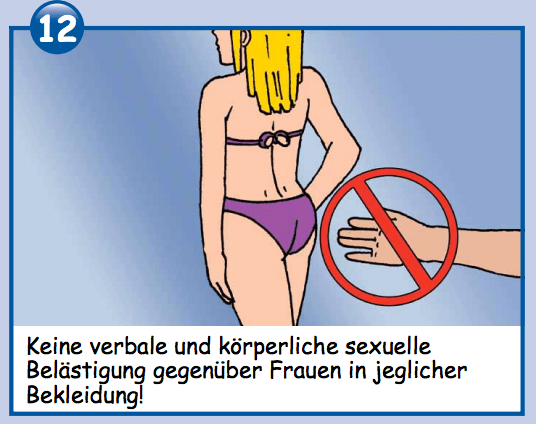
Where the language is a problem, as with “frustrated refugees,” a picture might do the trick. Here’s one that is intended to instruct young men in the fine points of living in a Western country, which with all its faults, has standards these young men might know nothing of.
Earlier this evening, we noted that the western German town of Bornheim has banned adult male asylum seekers from its indoor public pool after some German women complained of harassment.”
There have been complaints of sexual harassment and chatting-up going on in this swimming pool … by groups of young men, and this has prompted some women to leave (the premises),” the town’s deputy mayor said.
Bornheim, as it turns out, is just a stone’s throw away from Cologne where a wave of sexual assaults allegedly perpetrated by men of “Arab origin” at a New Year’s Eve festival has mushroomed into a bloc-wide scandal.
Now, officials from across Europe are struggling to deflect criticism and devise a way to ensure that women are safe in large crowds.
Trump relies on his ability to dominate the news with provocative distractions, to repel serious questions until interviewers’ time runs out. We in the media must find a way, if not to pierce the bluster, at least to expose it
She stamps her feet. He’s better than they are at communicating with (winning attention of, winning over) the masses. People get him, they don’t get Ruth Marcus et al., who are more interested in their own thinking than in their supposed audiences.
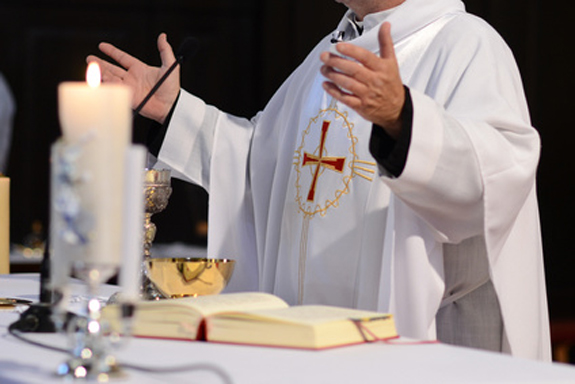
If you’re a daily Mass attendant, the odds are that you hear that norm violated a dozen times a week. Sunday Mass people typically hear it violated two or three times a week, at least.
Auto-editing or flat-out rewriting the prescribed text of the Mass is virtually epidemic among priests who attended seminary in the late Sixties, Seventies, or early Eighties; it’s less obvious among the younger clergy.
But whether indulged by old, middle-aged, or young, it’s obnoxious and it’s an obstacle to prayer.
I’m with this fellow, though less so since like Dr. Strangelove I have learned to stop worrying and love the — free-lancer.
Thing is, I can’t afford to be censorious in the matter. Talk about your obstacles to prayer. Been there, done that. No thanks.
Better to take it as part of the human comedy. Besides, currently I encounter far less of that lately: change of venue and all that, you know.
But I still encourage the writer, the eminent George Weigel, and applaud him.


 Blithe Spirit