Read it and weep

Toy Monster: The big, bad world of Mattel, by Jerry Oppenheimer, is scored by reviewer Eric J. Iannelli, in the 9/4/09 Times [of London] Literary Supplement for its triteness.  (On-line only for subscribers)

“As befits such a seedy, tabloid-style expose, the writing is cliched and hyperbolic,” writes Iannelli, giving some juicy particulars:

Investigators are “hard-nosed”.  It is the “tired,poor, huddled masses” who immigrate through Ellis Island.  Japan is “the Land of the Rising Sun,” Germany is “the Fatherland” and Hollywood is “La-La Land.”

Etc.  A main character in this non-fic account “always got what she wanted” and “never took no for an answer.”  Her rise is twice described as “meteoric,” she “goes ballistic.”  And especially good are the verbs used instead of “say” or “said”:  “Very few . . . say anything. . .  they observe, maintain, intone or opine.”

Ianelli still found the book “engaging,” even if “sensationalist” and “one-sided,” because it raises “legitimate concerns” such as “lavish executive bonuses . . . in the face of scandal and falling profits.”

And nobody kept inserting “you know” in the middle of sentences or between them.  If you heard them talking live, ah, that would be a different matter, I’m sure.

Mass transit misunderstanding

What we’ve got here is failure to communicate.

Bruso is a 67 year-old  Vietnam veteran, who apparently has some history of mental illness. While riding the bus in Oakland, he was talking to someone about getting his shoes shined for his mother’s funeral and a black man named Michael—whose last name is unknown—managed to get offended because the words “shoe shine”, “boy”, and “brother” were used in the same sentence. He confronted Bruso, who initially misinterpreted the man as offering to shine his shoes. Michael yelled Why a brotha gotta spit-shine yo’ shoes?” and “Why a white man can’t shine his shoes?”

The rest is on tape.  This blog reports, you decide.

Trip down academic lane: Boccacio vs. Chaucer vs. church

At Dominican U in RF last night, Robert Hanning from Columbia U. on confession in the middle ages.  Title led me to expect a socio-cultural explication but he was about close reading of Bocaccio and Chaucer. 

I found the former heavy-handed in his slashing attack on church practice, producing cartoon characters — opera boffo? — none of them credible or noteworthy.  The latter — dear Geoffrey — produced memorable people and made same points with relative understatement.  Subtlety, thy name is not an Italian one.

Considered a q. during post-lecture q&a, where was holy mother church during all this?  Besides indexing Bocaccio.  But H. was not attuned to that, or seemed not to be, or had simply ruled that out a la monograph-style, not to mention journal-ready text with references and attributions right and left.

Appropriate, in that he was keynoting a joint meeting of the Illinois Medieval Assn. and the Midwest body of medievalists, this in DU’s near spanking-new Parmer Hall on west side of burgeoned if not still burgeoning campus. 

From which I exited on Thatcher, by the way, using the easement much disputed by tree-huggers and forest preservers.  The trees did not cry out at me as I hung a left and headed south.

A nice evening, for $10 that included a sip of wine and bite of something beforehand, sitting and watching medievalists chatter in clumps.  A look at the ivory tower, you might say, without prejudice. 

But I had to think about what Ezra Pound would say, he who moved ever in the mainstream of (literary and other) life and preferred jumping to (fascinating, engaging) conclusions.  Takes all kinds.

Super bowl crowd? Chickenfeed . . .

. . . compared to the hundreds of thousands who watched chariot races in Nero’s day.  The Circus, where the races were held, had room for 300,000, in a city, Rome, with about 2 million people.  “The roar that assails my eardrums,” wrote Juvenal,

Means, I am pretty sure, that the Greens have won — otherwise,

You’d see such gloomy faces, such sheer astonishment

As greeted the Cannae disaster, after our consuls

Had bitten the dust.

The Greens were one of the top two teams, the other was the Blues.  At Cannae, in 216 b.c., Hannibal defeated the Romans.  Two consuls — comparable to the U.S. president, the highest elected officials — died in that battle.  But fans are fans, and you’d think the president had died, to look at them when their team had lost.

The translation and explanation are by Peter Green in his 1974 book, The Six Satires (Penguin).  Get it at ABE Books for a dollar plus $4 shipping.  Very clever and entertaining read, but always with an edge.

O’Brien advertises, Byrne speaks, Zuma weds

Slamming with faint damns: “O’Brien ad slams Stroger,” says Sun-Times head — hard copy, not online.

[Terry] O’Brien, president of the Metropolitan Water Reclamation District, says “we’re running strictly a positive campaign here,” but his veiled references to Cook County Board President Todd Stroger in the ad aren’t exactly happy talk. [Cute] 

Well he can’t do that.  Won’t get away with it.  He’s acting as if Stroger’s sales-tax hike were a major issue (as if Chi Trib were counting the days from hike to primary: Geez), as if Stroger’s hiring relatives and others from his ward to big-bux jobs without apparent overriding reference to qualifications were a major issue too. 

Listen: O’Brien won’t get away with calling voters’ attention to these things, even without mentioning Stroger’s name.  We, at least the Sun-Times, are up to this dirty pool.  NOTHING DOING.  [And leave Lisa Donavan’s cute stuff alone, you S-T copy editors, wherever you are.]

Blaming and doing: Meanwhile, in Chi Trib, a shot at perfectionism:

[S]ome Americans are hopelessly naïve in their expectations of what “the system,” much less a single person, can accomplish within an institution as complex as the federal government.

They are practitioners of the Blame Someone Syndrome that requires that someone be nailed for every conceivable misfortune under the sun. It’s as useless and adolescent as the Do Something Syndrome.

When something bad happens, the calls go out: “Do something!” Doesn’t matter what it is, something’s got to be done. And when that something doesn’t work, in kicks the Blame Someone Syndrome.

Thus spake Dennis Byrne.  Yes.  It’s a neurotic crankiness, of which if you promise not to tell anyone, I partake sometimes myself, expecting copy editors to see things my (far better) way.  It’s not gonna happen, I tell myself, but then I forget.

As for doing something, “Don’t just do something; stand there” is often the best solution.

Saying “I do”: Finally, “South Africa’s Zuma takes his bride, again,” LA times and Chi Trib have.

“There are plenty of politicians who have mistresses and children that they hide so as to pretend they are monogamous. I prefer to be open. I love my wives and I am proud of my children,” Zuma has said, defending polygamy in a television interview.

I find this disturbing not because I oppose polygamy, which I do, but because by being open about it, this president makes light of the tribute to virtue offered by hypocrisy.  Is nothing sacred?

Of course, we Americans should talk.  Our president has a father he dreamed about who had three wives.  So? You have a problem with that?

Carolyn socks it to Sassone

Oak and Forest Leaves longtime columnist Paul Sassone

needs a lesson in patience, humanity and environmentalism. Perhaps the next time he’s in the checkout line behind a responsible person who brought reusable bags to the store, he should worry less about his melting ice cream and more about the melting polar ice caps.

Says letter writer Carolyn James, complaining about his column [not available on-line] in which he makes fun of people bringing their own bags to the checkout counter for environmental reasons and making him wait.

Yahoo! Melting ice cream vs. melting polar caps!  No contest!

We’re keeping score, you know

What do you know?  We’re supposed to talk nice to people and not throw our weight around, and see how Obama-diplomacy worked in Cope-‘n-hang-in-there:

UK diplomatic sources . . . confirmed that China had taken huge offence at remarks by President Obama over the need to independently monitor every country[’s] carbon emissions.

In his speech President Obama said: “Without any accountability, any agreement would be empty words on a page”.

The Chinese delegation interpreted these comments as an attempt to humiliate them. It prompted Prime Minister Wen Jiabao to return to his hotel and send low level delegates to take his place in the talks. [Italics added]

But what’s a kid from the South Side supposed to do when faced with inscrutable people?

Studying Pilgrims and Indians

Very cautious Chi Trib story here, about second-graders at Beye School, Oak Park. 

The kids

spent two school days aboard a faux Mayflower ship in their auditorium, braving simulated storms, seasickness and even the birth of a baby.

The pretend Pilgrims . . . kept journals to explore their fears of moving to a new land. . . . .
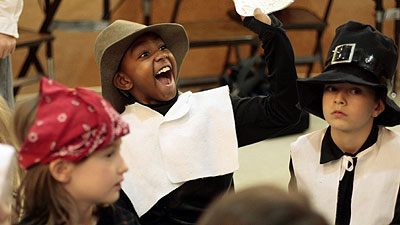
Beye kids 091125

Before the mock journey, they role-played and kept journals in a similar fashion as American Indians while studying different tribes.

The students also learned how some of the English settlers’ choices harmed indigenous people, examining both bright and tragic aspects of American history.

Many educators are striving to celebrate a more historically accurate Thanksgiving, ditching [sic] the stereotypical Pilgrim-and-Indian stories in favor of true [accurate?] social studies lessons. [Truly s.s. lessons, not faux ones?]

Teachers say a nuanced approach helps debunk popular myths and can add cultural awareness to the holiday. [Cliche hat trick there, dying for expansion and particularization]

“This makes history more real,” said Amber Schweigert, a second-grade teacher at Beye. [Italics added throughout]

Cautious because it tip-toes through minefields of cultural warfare, dropping hints.  The aim may have been to produce “a nice story,” as I heard a city editor speak approvingly many years ago and this writer may have heard a few days ago.  It ends up soft soap, tantalizing and deceptive.

Ron Grossman’s hard-copy, same-page [not web-site]companion piece produces something quite different.  It’s about

a number of Chicagoans who have discovered they are Pilgrim descendants and who gather on the weekend before Thanksgiving for a luncheon (yes, turkey). Someone reads the Mayflower Compact, a kind of mini-constitution the Pilgrims wrote just before landing at Plymouth Rock in 1620. Then the list of its signers is recited:

William Bradford, Myles Standish, John Alden

As each Pilgrim’s name is called out, his descendants rise.

The experience

“. . . sends shivers up the back of my neck, every time,” [Don] Sherman said. “Hearing the compact reminds me why it’s the first great historical document of our country.”

Grossman:

With only two sentences, the compact expressed a world-shaking idea: Ordinary people can govern themselves. In the 17th century, kings and nobles made the rules; others were to silently follow.

Not so among these settlers. A history lesson follows:

Originally called the Dissenters, [Pilgrims] were known and reviled for thinking outside the box, so to speak. [G. knows what he’s doing; semi-apologizes for radio-speak.]  They disliked what they considered the pompous Church of England and wanted to be ministered to by like-thinking preachers in simple churches. [Clean copy]

So the Dissenters went on a series of wanderings that would give them the name Pilgrims. They went first to what is now the Netherlands, even then an open-minded country. [A long-ago Dutch friend: French get ideas, Dutch have to try them.] Yet toleration presented another problem confronted by every immigrant group in whatever new homeland it chooses.

“Their children were becoming Dutch,” Morony said. “The Dissenters thought of themselves as English.”

They did not howl for bilingualism, whose day had not yet come, but like Huck Finn headed for the territory.

Fearing assimilation, a group of Dissenters planned a second exile: to a place far enough away from England that they could be free of the Church of England and yet still be English. Strangely, that agenda meshed with the thinking of London’s movers-and-shakers.

Late to colonizing, England wanted to catch up. So a scheme was hatched whereby the Pilgrims would be sent to New York as part of a commercial enterprise organized by English investors with the crown’s OK.

And off they went.  The rest is . . . [deleted as cliche] . . .

The content of their character

This from the redoubtable Heather Mac Donald in City Journal tells us what “even playing field” means to some people — equal results, across the board:

As part of its plan to comply with a federal desegregation order now decades old, Tucson’s school district adopted racial quotas in school discipline this summer.

Schools that suspend or expel Hispanic and black students at higher rates than white students will now get a visit from a district “Equity Team” and will be expected to remedy those disparities by reducing their minority discipline rates.

In Oak Park discipline rates are regularly discussed with a view to disparity of punishment.  Objectors to how more often blacks are punished even brought in elected officials from outside Oak Park.  But nothing like this has happened.  No one has called from a quota that I know of.

As for the language abuse embodied in that “playing field” stuff, it’s been lambasted best by George Orwell in his “Politics and the English Language,” in which he notes the role of language in stultifying our processes:

[Our language] becomes ugly and inaccurate because our thoughts are foolish, but the slovenliness of our language makes it easier for us to have foolish thoughts.

The ebullient, even bombastic Ezra Pound was even more condemnatory in “A Problem of (Specifically) Style” in 1934:

[A] tolerance for slipshod expression in whatever department of writing gradually leads to chaos . . . and a progressive rottenness of spirit.

In Tucson the pattern seems clear enough:

Tucson’s administrators explain their disciplinary quota pressure on the ground that students removed from class lose valuable learning time, exacerbating the already great ethnic academic achievement gap.

Such thinking ignores the students who are not disrupting class or threatening teachers and who also lose valuable learning time when unruly or violent students remain in the classroom.

Mac Donald adds:

Surely those students have a greater claim to “equity” in school resources than gang members do.

Schools are to look for “root causes” in bad behavior.  Mac Donald:

I can save them some time: the root cause of disparate rates of suspension is disparate rates of bad behavior.

“Single parenting” is the biggest one.

If the Tucson school board wants to publicize the essential role of fathers in raising law-abiding children, it might start solving the problem of disciplinary imbalance.

But until then, it should let schools resolve their discipline problems in a color-blind fashion, without worrying about a visit from an “Equity Team.”

It’s “the content of their character,” as Martin Luther King said in his “I have a dream” speech.

Rev. Jesse Jackson wants no part of that.  He calls invoking King in this context is “intellectual terrorism.”  Orwellian, right?