Elementary, my dear Holmes . . .

, . . . , which wasn’t named for Sherlock

Oak Park’s Holmes School is named for Oliver Wendell Holmes Sr., a medical doctor and magazine columnist who combined the two skills to help make childbirth safer for mothers.

As a medical man, he taught at Dartmouth and Harvard, serving at Harvard for a time as dean of its medical school. He made his mark in medical history with his landmark 1843 essay, “The Contagiousness of Puerperal Fever,” about the “black death of childbed,” which was taking a terrible toll on mothers giving birth. Doctors and nurses were to blame who did not wash their hands before helping a woman deliver, he argued.  . . . .

If this be the Wednesday Journal column for July, which it be, make the most of it.

What helps

THIS HELPS . . . . A line from the Gospel that rang true for me was “I believe, Lord. Help thou my unbelief.” Another, from St. Paul, says we will see things clear in heaven but now only “through a glass darkly.” Not to worry, you who think you are of little faith.

ASSESSMENT . . . . Here’s an aptly stated judgment, rendered at the end of a Power Line dissection of Obama’s claim for Banking Committee membership as part of his newly discovered toughness toward Iran:

Barack Obama has proved himself an extraordinarily cynical politician. He doesn’t believe in much, but he certainly believes in his own power to make voters believe whatever he says, even when what he says today contradicts what he said yesterday, and even when it constitutes a bald fiction, such as his claim that the Senate Banking Committee is “[his] committee.”

Some day it may begin to dawn on attentive observers that Obama represents a type that flourishes on many college campuses. The technical term that applies to Obama is b.s. artist. Obama is an overaged example of the phenomenon, but his skills in the art have brought him great success and he’s not giving it up now.

Some day.

REACTION . . . . I told an Oak Parker about recent armed robberies in the village, including one in the block next to hers, and she said, “People are really getting desperate,” identifying instantly with the guy holding people up. She also wants to fight terrorism by going after the root causes?

ANTIDOTE . . . . Here’s a possible antidote to this people-getting-desperate approach: Shooting Back: The Right and Duty of Self Defense, by Charl van Wyk. He was a missionary in S. Africa in 1993 when terrorists attacked his church during worship. He shot back and saved lives, though not all, and it’s called a massacre. In his book he makes

a biblical, Christian case for individuals arming themselves with guns, and does so more persuasively than perhaps any other author because he found himself in a church attacked by terrorists.

“Grenades were exploding in flashes of light. Pews shattered under the blasts, sending splinters flying through the air,” he recalls of the July 25, 1993, St. James Church Massacre. “An automatic assault rifle was being fired and was fast ripping the pews — and whoever, whatever was in its trajectory — to pieces. We were being attacked!”

But van Wyk was not defenseless that day. Had he been unarmed like the other congregants, the slaughter would have been much worse.

“Instinctively, I knelt down behind the bench in front of me and pulled out my .38 special snub-nosed revolver, which I always carried with me,” he writes in “Shooting Back,” a book being published for the first time in America next month by WND Books. “I would have felt undressed without it. Many people could not understand why I would carry a firearm into a church service, but I argued that this was a particularly dangerous time in South Africa.”

During that Sunday evening service, the terrorists, wielding AK-47s and grenades, killed 11 and wounded 58. But the fact that one man – van Wyk – fired back, wounding one of the attackers and driving the others away.

SITTING, KNEELING . . . . Reading in May ’08 New Oxford Review of Donna L. Kruger’s complaint about half sitting, half kneeling worshipers — “Our Lord in the Blessed Sacrament must surely be offended” — instead of sitting straight up if you have to if elderly and/or with “sore or weak knees,” I was offended mightily, being one of the last mentioned, though also elderly, I guess.

Then imagine my delight in reading the July-August issue with two excellent letters, one from a 71-year-old arthritic male from West Palm Beach, Florida, “with a knee wrecked in a skiing accident fifty years ago,” who does the half and half, partly out of concern for the worshiper kneeling behind him, presumably with strong, healthy knees, for whom it would be “awkward” otherwise. As for offending the Lord, “Who knew?” he asks.

The other letter, from a Very Reverend in Vladivostok, notes perceptively that Americans are getting “bigger year by year” and “half and half may be the only way some of us will be able to kneel” in the churches he visits in Eastern Poland, where kneelers are squeezed in for space considerations.

THOUSAND-WORD SPECIAL . . . .

Kc CHIX

These animal activists can get active whenever they want, as far as I’m concerned.

This guy has my vote too:
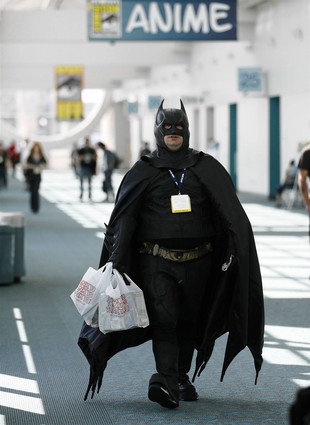
BATMAN COMIC

GOOD BOOK . . . . Only at page 548 of Prince of Darkness, Robert Novak’s memoir, did I encounter the second name that I did not recognize. The individual had been identified a few pages earlier, but it hadn’t stuck. That’s how good a book this is: it keeps you attentive and it makes identities clear along the way — two signs of clean copy.

QUOTE . . . . And our wise(guy) quote of the day about newspapers:

If one morning I walked on top of the water across the Potomac River, the headline that afternoon would read:  “President Can’t Swim.”  ~Lyndon B. Johnson

Read this book . . .

Alan Bennett’s The Uncommon Reader (Farrar Straus & Giroux, 2007), a novella, is such a good book. The reader is the current Queen Elizabeth, who picks up reading in the years immediately preceding her 80th birthday and finds it liberating and elevating. It’s a book about reading and the life of the mind and coming to terms with oneself.

In the end she turns to writing, which leads to a stunning denouement better left unrevealed here. Writing her memoirs, that is, but not showing and telling with them: no gossip but “analysis and reflection,” as she tells her assembled privy councilors from her 50-plus years as queen, gathered for her birthday in a festive tea.

Proust weighs heavily in this decision. So does Ivy Compton-Burnett, whom she had “damed” some time back without reading a thing she had written. Wonderful, wonderful book.

Buy it here, through Google, or here, at ABE Books.

A book for our age

This fellow has it right: “Right wingers love Friedrich Hayek.”  I do.

Ronald Reagan and Margaret Thatcher cited his ideas as central to the social revolutions they hoped to spark.

Did not know that but am glad to hear it and am not surprised.

Antigovernment ideologues admire him as one of those few who kept Adam Smith’s fires burning during the dark reign of John Maynard Keynes in the West; his most famous book, The Road to Serfdom, has sold more than 350,000 copies in the United States alone.

I bought it.  If that be ideologuism, make the most of it.

And the modern right has enlisted Hayek as a political weapon: Why can’t those loony lefties acknowledge the simple and obvious truths that he understood?

Wait.  This too is news to me.  Hayek is not quoted much in what I read.  As for why loony lefties don’t buy H., it’s because they are stupid, that’s why.

This fellow — Jesse Larner, author of Mount Rushmore: An Icon Reconsidered (Nation Books, 2002) and Forgive Us Our Spins: Michael Moore and the Future of the Left (Wiley and Sons, 2006), writing in Dissent for Winter 2008 — has been reading up on Hayek, he said, “much as, in my twenties, I decided I really ought to read the Bible [because it’s] influential, whether I it or not.”

He has found him “a surprise, in several ways, nowhere near as extreme as his ideological descendants.”

But he makes “a powerful and far-ranging critique of state control of economic life.”  What makes for serfdom, in Hayek’s argument.

Keynes called it “a grand book.”  Orwell found in it “a great deal of truth . . . collectivism is not inherently democratic, but, on the contrary, gives to a tyrannical minority such powers as the Spanish Inquisitors never dreamt of.”

But in Road, says Larner, Hayek “thoroughly, eloquently, and convincingly demolishes an idea that virtually no one holds nowadays.”

In 1944, however, when it was published?  The conventionally wise were horrified at it then and condemned it right and left.  In the U.S., nonetheless, it sold immensely well, because it shot down conventional (Keynesian) wisdom.

And today there are governmental meddlers who want so much to run things, thinking they know best, which they do not.

It’s a relatively simple, small, moving book, a sort of catechism or introduction to free-market thinking, based on the revolutionary notion that human nature “is what it is,” to use a catch phrase of our day, meaning you can’t get away from it.

Try reading it here.  Or buying it here or here.

George and Caroline and their son Fred

George II of England and his queen, Caroline, had no use for their son Frederick, Prince of Wales, who returned in 1733 from schooling in his grandfather’s home city or state of Hanover, Germany. He had no use for them either, and some close observers were worried, including Lord Hervey, who discusses it in his Memoirs.

The prime minister, Robert Walpole, urged the parents to make it up with the son, whom their enemies would play against them, but they said no, you don’t know him like we do — and he did turn out a nasty fellow before his death in 1751, nine years before his father’s. There was no use being nice to him, they said; it will only make him worse.

Hervey had already tried, with some success, to mollify the son, whom he had served as advisor. It was a no-win situation, he told him. The king has many enemies, and you all have much to lose, nothing to gain. The prince seemed to take it to heart. Would the parents do so too, if some dared to tell them about the enemies in their midst? Hervey thought so and told Walpole as much.

Walpole agreed that the king should use “supple insinuating arts” to make friends, rather than engage in such a “fierte” — “wildness” or “fierceness” — involving his son and heir, and should cease his “awkward, simple, and proud conduct.” But he was buttering no one up, nor was he spreading cash around, and so no one had a good word for him, in and out of the palace. He had neither “address” enough to do the first nor “liberality” enough to do the latter.

But Walpole would “not dare to tell them of the ticklish situation they are in,” said Hervey, warning him that when matters went bad, he and other ministers would get the blame.

At this point the two interrupted by the Duke of Newcastle, who entered “with as much alacrity and noise as usual . . . in his hand a bundle of papers as big as his head and with little more in them.”

In any case, Hervey eventually warned the royal couple by reporting what he said he heard others say, having got their acquiescence in his not revealing his sources, which were nonexistent. In this way he could give his own ideas as if they were others’ and thus escape censure.

The devil you say

Hawthorne and Emerson did not see eye to eye when it came to “what evil lurks in the hearts of men.”

In one of his stories, [Hawthorne] has the devil say, “Evil is the nature of mankind.” [he] didn’t go that far, but argued time and again for the “evil impulse” in us all. “Oh, take my word for it,” his devil taunted reformers, “it will be the old world yet!”

Emerson, on the other hand, found The Scarlet Letter a “ghastly” book, apparently recognizing it as an attack on his feelings-based morality.

Read all about it in The Wednesday Journal of Oak Park & River Forest, out today, with special attention to “three discarded Oak Park school namesakes” — these two plus James Russell Lowell, whose paean to June — “what is so rare”? — gets special billing.

AIDS for everybody!

Here’s to “one of the most distorted, duplicitous and cynical public health panics of the last 30 years”:

After 25 years of official scaremongering about western societies being ravaged by the disease – with salacious, tombstone-illustrated [UK] government propaganda warning people to wear a condom or “die of ignorance” – the head of the World Health Organisation’s HIV/Aids department says there is no need for heterosexuals to fret.

It’s “a high-level admission that there is no threat of a global Aids pandemic among heterosexuals.”

Instead of being treated as a sexually transmitted disease that affected certain high-risk communities, and which should be vociferously tackled by the medical authorities, the “war against Aids” was turned into moral crusade.

Without foundation, and that was known as early as 1987, when there was

“no good evidence that Aids is likely to spread rapidly in the West among heterosexuals.” In Britain, most of the small-scale spread of “heterosexual Aids” has been a result of infected individuals arriving from Africa. In the UK in the whole of the 1980s – the decade of the Great Aids Panic – there were 20 cases of HIV acquired through heterosexual contact with an individual infected in Europe.

For that matter, on this blogger’s book shelf is a 1990 book, The Myth of Heterosexual AIDS, by Michael Fumento, which argued, a Washington Monthly reviewer said, that:

the vast majority of Americans are more likely to meet Shirley MacLaine in a different life than to contract the deadly HIV-virus, and that the only reason the news hasn’t gotten out is that a conspiracy of self-interested scientists, opportunitistic politicians, sensationalist journalists, conservative moralizers, and fearful homosexuals have manufactured the scare.

They apparently sought to incite the madness of crowds, as current a problem as when witches were hunted a long time ago.  Man-made, preventable global warming, anyone? 

Book editors have principles too, you know

Mainstreamers would rather not do this book on Iraq war planning by one who was there — Douglas Feith’s War and Decision: Inside the Pentagon at the Dawn of the War on Terrorism — notes Christopher Hitchens.

As I write this on the first day of June, about a book that was published in the first week of April, the books pages of the New York Times, the Washington Post, the Los Angeles Times, and the Boston Globe have not seen fit to give Feith a review.

Yes, they’re busy, not least of all with McClellan’s tell-all, What Happened: Inside the Bush White House and Washington’s Culture of Deception, which appeals them more.  Fits their narrative, you know.

Not only book pages and sections have been missing in action surrounding Feith’s book, but news pages too: NY Times spiked a James Risen story about it.

“This all might seem less questionable if it were not for the still-ballooning acreage awarded to Scott McClellan,” says Hitchens.

Reader M. heard Feith on Hugh Hewitt, says he sounded “very balanced for a major player,” comments:

The MSM is doing a complete black-out on his book, print, TV, radio. I surmise one will only find it buried behind a copy of “How to parse intransitive verbs” in Border’s, as well. Amazon gives it 3 1/2 stars; Scott McClellan’s book 4 stars. Go figure.

Finding the father while running for office

This could be the first presidential campaign dedicated to a candidate’s finding himself.  Obama dreamed of his lost father and wrote a book about it, and thereby hangs the narrative.  In it he exposed himself more mercilessly and more literately, indeed literarily, than any other candidate.  His book has become a gold mine for non-M.D. analysts and may yet be for M.D.’s if he loses and his supporters go into tailspin.

There is none better of the former than Shelby Steele, whose A Bound Man: Why We Are Excited About Obama and Why He Can’t Win draws forth from Dreams the stuff of personal travail.  For instance, the young Obama, faced with being either black or white, chose black.  His white girl friend in New York, after Harvard Law, had it out with him in the matter of racial identity, feeling bad that she couldn’t share his.  He admits he treated her badly.  They broke up after a year.

Earlier, at Harvard, he had mildly hit on a mixed-race coed, asking if she was going to the black students meeting.  Not on your life, she said, giving him an earful about being both white and black and in no way about to downgrade her “sweet” Italian father by buying into black power.

In Chicago Obama chose his church as conferring on him or initiating him into Afro-centeredness.  Street credentials (“street cred”) were not as much the issue, Steele implies, as the need to belong to one race.  Steele knows about that, having been a sort of Obama character himself as a young man with white mother and black father. 

We read and hear of the choice as motivated by the need to succeed as an organizer.  Steele ignores that.

As for the coming campaign and a search for identity, it seems that Obama has more to lose than an election.  At stake also is his blackness, which Steele persuasively analyzes as a social construct with its own rules.  These include black superiority and white perfidy.

So there’s the candidate with his need to be black and his need to be the man of the hour for us all.  The father matters, but so does getting elected.

Double tall, with or without

Starbucks sells coffee, ambience, “a cosy living room,” and that’s its secret, you may think.  But consider this:

Starbucks sells milk. The Frappuccino, which Clark calls a “glorified milkshake”, is the product that catapulted the company into market domination. The secret of Starbucks’ success is that Americans love their dairy.

That’s Jakob Norberg in Times Literary Supplement for 2/29/08, reviewing Taylor Clark’s Starbucked: A double tall tale of caffeine, commerce, and culture

So.  Milk sells.

Another reason I have read somewhere for S’buck’s success is its marketing idea that you come in for coffee and are encouraged to hang around.

This author lays out complaints against the company but ends in defusing them.

For instance: while there are many stories of Starbucks’ fierce business practices, there is little evidence that it pushes people out of the market. If anything, it has inspired a greater interest in quality coffee and, as an unintended effect, the number of independent coffee houses has increased greatly.

So.  The better mousetrap led to imitators trying to better the better.  We call it competition.