Digging deep for a friend

Don Heyrman is obituaried in S-T today. He died a week ago today, a month short of his 91st birthday, having lived 50 years in Evanston. He plugged away all his life at civic and social concerns and what was known as “Catholic Action” in a bevy of organizations — National Association of Laymen, Chicago Conference of Laymen, Conference of the Laity, Christian Family Movement, Catholic Interracial Council, World Congress of the Lay Apostolate in Rome. A man generous with his time, while raising a family and working as a marketing manager for a major corporation.

Generous too with his cash, on a moment’s notice, as I discovered, calling him up one day long ago from the news room to tell him that Msgr. Jack Egan, then a Lawndale pastor, had worn out his credit with a card company and needed bailing out. I’d had a call from a Jesuit who was living with Egan (and many other activists) in the Lawndale parish. I called Heyrman, a friend of Egan’s, to see what he could do. “Well,” he said, with barely a pause, “my wife and I didn’t need that vacation anyway,” and he said he’d cover it.

How’s that for a measure of character?

Flunking govt test ain’t necessarily bad

Wheeling Jesuit U. is not alone in flunking the government’s “financial-responsibity” test, as was reported yesterday. Some of the others are knocking down the feds’ argument:

The test is founded on a business model, and nonprofits dont really operate in the same way, Daniel Anderson, who since 1981 has served as president of Appalachian Bible College near Beckley said.

Because the test rewards schools that have a large amount of liquid assets, a school thats expanding and spending money on new facilities will score lower, Anderson said.

. . . theres a fallacy in the formula the Department of Ed uses, and Ive been saying that for many years, he said. A school like ours isnt going to just build up cash. When we get money, we want to put it into use.

Another days it’s old news:

At Ohio Valley University in Wood County, the news, well, wasnt news. I still dont understand all the excitement about OVU being on the (Education) Departments list, Steve Morgan, the schools executive vice president, said in a news release.

Morgan, who previously served as the schools chief fiscal officer, said Ohio Valley has been on the list for a decade as it purchased land and made other upgrades to become a full baccalaureate program.

The Education Departments tool to measure financial strength depends heavily on a comparison of a schools debt to its assets, Morgan said. By that definition, he said, Ohio Valley University has continued to score poorly despite growing enrollment, a top ranking in US News & World Report and other indicators of strength.

Anyhow, Ohio Valley U. is staying on the flunk list: Its a fact of life here and will continue to be so for years to come, said Morgan. The OVU president, E. Keith Stotts also demurred:

What I regret is the implication that Ohio Valley University is teetering at deaths door, he said. . . . . Just because the school shows up on the governments list doesnt mean the school is struggling, Stotts said. OVU is a true success story, the Departments list not withstanding, Stotts argues. Lord willing, our university will continue its mission of transforming lives for many years to come.

Besides Wheeling Jesuit, two other West Virginia institutions were cited: Alderson-Broaddus College in Philippi; and Davis & Elkins College in Elkins.

I like the spirit the first two show.

Wheeling Jesuit hard-pressed

Hard times at Wheeling Jesuit — one of 321 privately operated colleges (for and not for profit) that failed the U.S. Department of Education’s 2009 financial responsibility test. That means more hoops to jump through to keep aid going to the 97% of WJU students who receive it.

[Interim Pres. Sister Francis] Thrailkill said this is the first time WJU failed the test. . . . [C]olleges who score a 1 to 1.4 on the test are considered to have failed, but can still participate in federal financial aid programs, but there are a few restrictions. If a school scores in the negative, they are subject to extra requirements. WJU scored a 1.1.

Thrailkill wants to point out that WJU was notified about this issue several months ago, and said they have taken steps to improve their financial situation.

It may be standard to keep this quiet, but The Chronicle of Higher Education apparently operates under no such compulsion.

More details:

All private colleges that award federal student aid must participate in the Department of Education’s financial-responsibility test, which is based on information from their audited financial statements. The department develops a composite score on a scale of 3.0 to minus 1.0, based on financial ratios that measure factors such as net worth, operating losses, and the relationship of assets to liabilities.

Yet more, from a separate Chronicle story:

A total of 150 private nonprofit colleges failed the . . . test, [which is] based on their condition in the 2009 fiscal year . . . That’s 23 more than the 127 that failed the test in the 2008 fiscal year, and an increase of about 70 percent over the number of degree-granting institutions that failed two years ago.

WJU has company.

Same-sex ministry

New improved version of my Chicago Catholic News story (now trashed to cache) about same-sex ministry is up.  It begins:

Church Reporter: Priest in business of “helping same-sex-oriented people calm their urges and live chaste lives


(UPDATED: 7/22/10) Speaking at the monthly Catholic Citizens of Illinois luncheon on July 9, Fr. Paul Check pressed one of the hottest social-climate buttons around, converting same-sex people to opposite-sexers — in their behavior if not in their orientation.

As recently installed national director of Courage, which performs chaplain services for 12-step programs in 100-plus U.S. dioceses, including Chicago and overseas, he’s in the business of helping same-sex-oriented people calm their urges and live chaste lives according to Church teaching.  . . . .

Thank you for your patience in this matter, and call again.

===============

Later, from my heterosexual buddy in Ann Arbor,” a cautionary, nay, a wholly negative note:

Rots a’ ruck to the well-intentioned Fathers.  My biased view is that (beyond sincere) prayer there is little that Priests or any others can do to redeem committed homosexuals.

Admittedly, my view is  biased by my experience as a practicing (psycho)therapist, from which vantage point, I failed over and over again to recover  normalcy for homosexual patients who (GENUINELY AND DEEPLY, AS IT SEEMED TO ME) wanted to regain their preference for normalcy — at the end, I felt that the failure was mine, and that the disorder was (by its origins and sub-societal support) a chosen style of life, rooted in some basic physical disorder, and thus (ought)not be subject to moral condemnation.

Whatever the truth of all of this, I came away from this professional experience convinced that the victims of the disorder had no personal responsibility for the homosexual lifestyle that they practiced, and thus should be as immune from social condemnation as are persons who suffer from arthritis or post-traumatic anxiety.

More to come, from this quarter, about whether changes can come to these individuals.

Jesuit want ads aren’t working

Wheeling Jesuit U., unable to fill its open presidency with a Jesuit, has company. Gonzaga U., in Spokane WA, for one, which has promoted its acting president, a 44-year-old layman, to president, suspending its bylaws to do so.

For another, Creighton U., in Omaha NE, is finding “a good Jesuit hard to find.” Its search committee

might bump into a 21st century reality that’s increasingly pushing other Jesuit universities to hire non-priests as presidents.

Nobody wants to see the day (of a non-Jesuit president) come, but it might come. We have to deal with that, said Bill Fitzgerald, the chairman of Creighton’s board of directors

The day has already come for nine of the 28 Jesuit universities in the U.S., each with a permanent or interim president who is not a Jesuit priest, Rev. Charles Currie, president of the Association of Jesuit Colleges and Universities, told the World-Herald.

We used to assume that (the president’s job) could only be done by a Jesuit, but we’ve learned over the years that it isn’t true, Currie said. It’s not something we should be fearful of. . . . . There’s clearly value in having a Jesuit, but if that person is not available, you have to move in other directions.

Be that as it may, Currie, who was Wheeling Jesuit’s president 1972-82, was an early (and repeated) defender of Wheeling Jesuit’s surprise ouster of its Jesuit president last August after only two years. In the stormy aftermath of the firing, Currie cited “confidentiality” requirements, inadvertently encouraging suspicion by alumni and others of scandal — which was never either alleged or demonstrated. Three Jesuits acting as Wheeling Jesuit trustees, effected the firing. One of the three was himself later replaced by a layman as president of University of Detroit-Mercy.

Wheeling Jesuit suspended its own search in late October, by which time no Jesuit had applied for the position. Last February the university hired a nun, Sister Francis Marie Thrailkill, as new interim president.

Somehow beating RC bishops to the punch

From CNS News about rattling the U. of Illinois cage:

The Alliance Defense Fund, a Christian legal group, has given the University of Illinois at Urbana-Champaign until the end of Friday to re-instate a professor who was relieved of his teaching duties following complaints he engaged in hate speech by teaching students about Catholic teaching on homosexuality in a course about Catholicism.

If he’s not reinstated, they will seriously . . . consider a lawsuit, fund lawyer Jordan Lawrence told U. of I, calling the student’s complaint about Dr. Kenneth Howell, the (adjunct) professor in question, a hecklers veto unworthy of the university’s response, which he called heavy handed [and] authoritarian not the way classrooms should function at universities in the United States.

The fund’s blue-ribbon board of directors includes executives of Crusade for Christ International, Focus on the Family, and Fellowship of Christian Athletes. Not an RC bishop among them. What do you know about that?

Wheeling Jesuit philosophy prof arrested on abuse charge

Bad news out of Wheeling WV, about a Wheeling Jesuit U. philosophy teacher, an African priest, who has been jailed in Virginia on a sex charge.

The Rev. Felix Owino, a priest in the Religious Missionary Institute of the Apostles of Jesus, was arrested on July 8 in Fairfax, Va., on charges of aggravated sexual battery of a minor.
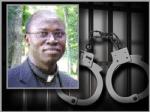
Fr. Owino, a native of Nairobi, Kenya, with a Ph.D. from Duquesne University in Pittsburgh, was on summer break, visiting a Herndon (VA) family he knew well. The battery occurred in the family home, according to the charge. The alleged victim is an 11-year-old girl, a member of that family.

He taught at Wheeling Jesuit since 2008, first as a visiting professor, eventually (by July 4) an assistant professor. Most recently he taught an online course in Logic and Knowledge (PHI 105-81), in the first summer session, May 17 to June 28. He lived in a Weirton (WV) parish, saying mass and preaching on weekends. As of July 12, four days after his arrest, he had “no current responsibilities at the university and [was] not expected to return to campus,” the university announced, adding, “During his two years at Wheeling Jesuit, the campus authorities received no student complaints about his conduct.”

Information about him had been scrubbed from the university web site, including this paragraph, available through the Google cache:

Felix Charles Owino, A.J. is a member of the Religious Missionary Congregation of the Apostles of Jesus, the first African Congregation for Africa and the world. Fr. Felix has B.A , M.Th from Apostles of Jesus Affiliate of Urbanian University, Rome; M.A., Ph.D in Philosophy from Duquesne University. He has worked also as an administrator in Uganda Rector of Apostles of Jesus Minor Seminary; also as Rector of the National Shrine of the Most Sacred Heart of Jesus and Immaculate Heart of Mary in Nairobi Kenya. In United States, Fr. Felix worked in different Universities and Colleges of Higher Learning both in administrative and faculty capacities before joining Wheeling Jesuit University as Assistant Professor of Philosophy.

The arrest itself:

Fairfax County police responded late last Wednesday to the residence on Franklin Farm Road, where 44-year-old Felix Owino was accused of touching the child inappropriately, Officer Bud Walker, a Fairfax police spokesman, said.

Owino was considered a longtime friend of the family, Walker said.

He was being held without bond at Fairfax County’s Adult Detention Center, with a hearing set for Sept. 2.

Later:

A brief, thorough local story here on the arrest, adding a few details:

On July 8, Felix C. Owino was arrested in Herndon on one count of aggravated sexual battery, according to Fairfax County police. Police responded to the home on Franklin Farm Road, where Owino, 46, was accused of touching the girl inappropriately, said Bud Walker, a Fairfax County police spokesman. Walker said Owino, who remained on the scene and had not attempted to leave, is a longtime acquaintance of the Herndon family. The girl was not physically injured, according to police.

Owino is currently being held without bond at the Adult Detention Center in Fairfax County. A hearing is set for Sept. 2, according to the Catholic Diocese of Wheeling-Charleston in West Virginia. No attorney information has yet been made available. Owino’s charges carry a maximum penalty of 20 years in prison, and up to a $100,000 fine, Walker said.

He didn’t try to leave.  He faces a stiff punishment.


Decline & fall of a sermon-time doze

I was neither flummoxed nor gobsmacked when the preacher tossed off a reference to “Captain Grimes in Decline and Fall” this morning.  I was, however, wakened from that pious semi-slumber that too often attends sermonizing.

Of the Roman empire? I wondered, distracted from my fascination with the family of mother, father, and seven kids aged an estimated six months to 10 years old in the pew in front of me.

No, I quickly decided.  Decline and Fall as by Evelyn Waugh.  Said and done.  Without explaining, as in saying, “I was reading a novel the other day called Decline and Fall, by the English Catholic writer Evelyn Waugh, and in it he said . . .”   Blah, blah, and blah.  What you hear in your average parish.

So it goes.  Point he was making would not have been lost, however, on the listeners who got not the reference: Captain Grimes enuntiated the wild “liberal” claim that freedom (and contentment) lay in doing whatever one wants to do, wherever, at any time.  Didn’t work that way for him in the novel, my priest said, going on to point out what should be obvious but isn’t: things don’t work that way.

So.  I was out of my reverie and on my way to a contented half hour or so of doing what I wanted to do, where and when I wanted to do it: hear the rest of mass and let the mystery of it wash over me, not to mention an edifying drama in which two young parents worshiped on Sunday in the company of their seven perfect youngsters.

Not bad, and I had only to walk a half mile to find it.

The St. Patrick’s thing

St. Patrick’s message “often gets drowned out by the parades, the plastic shamrocks and the green-dyed beer,” says Brother Colmán Ó Clabaigh, OSB, in The Catholic Spirit of the St. Paul & Minneapolis archdiocese.  Bold words, verified by reality.

He wrote two letters in the fifth century as a missionary to Ireland, in which (a) he condemns a chieftain for enslaving converts and (b) tells about himself and his work.

He’d been captured himself from his posh family villa in Britain and ended on a hillside herding sheep.  In desperation he turned to God and Jesus.  Escaping, he made it back to Britain and became a priest.  Could have enjoyed life as a pastor but decided to go whole-hog and return to Ireland to see what he could do for and with his erstwhile captors.

Altruistic, to be sure, but he had a skeleton in his closet, some crime committed when he was 15 that might have disqualified him for the ordination.  He admitted it to a friend, who betrayed his trust.  Patrick was attacked by “men of letters, sitting on your estates.”  He defended himself in his “Confession.”

He made an unlikely bishop, he admitted, “rustic, exiled, unlearned” as he was, “like a stone lying in deep mud.”  But “he that is mighty” had picked him up and made him part of a wall of the sort that lined the Irish countryside.

Bishop material or not, he recognized “the Gospel’s power to transform, transfigure and uplift,” Brother Ó Clabaigh, of Glenstal Abbey in Ireland, concludes.  Recognizing this was the secret of his success, “and this is as true for us in the 21st century as it was for him in the fifth.”

End of St. Patrick thought for the day. 

The Medjugorje connection

“The devil inside the Vatican” made a big splash in the UK Times with help from Drudge, a week after it broke in lesser pubs.  It’s a feud between exorcists, per a story by Stephen K. Ryan at ministryValues.com, who says it’s a matter of dueling exorcists.

“Well known Vatican Exorcists” Father Gabriele Armoth and Bishop Andrea Gemma have sharply different views of the scene at Medjugorje, a small village in Bosnia-Herzegovina where many believe the Virgin Mary “has been appearing and giving messages to the world” since 1981.

Amorth,  a renowned exorcist  and vigorous supporter of Medjugorje (He called it a “Fortress against Satan”)  in Rome  released a book of memoirs in which he declares to know of the existence of Satanic sects in the Vatican where participation reaches all the way to the College of Cardinals.

In 1973 he backed up the film “The Exorcist” as “substantially exact.”  In the Medjugorje experience, he sees a remedy now for Satanic influence in the Vatican, concerning which he says Pope Benedict “does what he can,” which apparently is not enough.

Bishop Gemma, on the other hand

one year ago . . .   denounced the alleged visions of Our Lady . . . as the “work of the devil” and a “diabolical deceit” [and] has rejected claims made by the six Bosnian ‘seers’ that they have seen the Virgin Mary “thousands [of] times over the past 27 years.”   

He told an Italian magazine, “In Medjugorje everything happens in function of money: Pilgrimages, lodging houses, sale of trinkets. . . .  It is a scandal.” He predicted a Vatican crackdown on the promoters of the visions.

Indeed, in September, 2008, the Vatican did discipline one of them, Rev. Tomislav Vlasic, a Franciscan priest, “for failing to cooperate with a Vatican inquiry” following his being reported “for the diffusion of dubious doctrine, manipulation of consciences, suspicious mysticism, disobedience toward legitimately issued orders” and charges that he “violated the Sixth Commandment,” Australia-based Cath News reported.