Travels with Barack

The view from Jerusalem:

[I]f Obama feels that he has to be the one to greet a man like Chavez, must it be with the kind of ear-to-ear grin that one might show girl scouts selling cookies? It must surely be disheartening for those who suffer oppression in countries like Venezuela, Cuba and Saudi Arabia to see the American president backslapping their oppressors when these victims have always looked up to the United States as their champions.

There was more, as we know, including:

the incident of President Barack Obama seeming to bow before King Abdullah of Saudi Arabia at the G-20 summit in London. The president’s people denied it was a bow, but it certainly was a sign of great deference from the American president to the dictator of a country who just six weeks ago sentenced a 75-year-old woman to 40 lashes for having been secluded with her nephew after he delivered bread to her home.

And then there’s the overture to Cuba,

a country which engages in systemic human rights abuses, including torture, arbitrary imprisonment, unfair trials and extrajudicial executions. Censorship is so extensive that Cubans face five-year prison sentences for connecting to the Internet illegally. And not only is emigration illegal, but even discussing it carries a six-month prison sentence.

He’s too bad to be true:

While he was campaigning for the presidency, Obama promised, “As president I will recognize the Armenian genocide.” But in a press conference in Ankara with President Abdullah Gul, he refused to use the word “genocide” when challenged by a reporter on the issue. Yet, it was Obama’s early foreign policy adviser Samantha Power of Harvard who wrote A Problem from Hell, the definitive book on the American non-intervention in repeated 20th-century genocides, beginning with the Armenian genocide perpetrated by the Ottoman Turks which killed 1.5 million between the years of 1915 and 1923.

The book changed the writer’s life, he says, he being a Jew who does not want the world to forget the Holocaust.  He presents a scenario:

Suppose Obama succeeds in building friendships with Chavez, Castro, Ahmadinejad and the Taliban. What then? Does America still get to feel that it stands for something? Will we still be the beacon of liberty and freedom to the rest of the world, or will we have sold out in the name of political expediency? And do any of us seriously believe that presidential friendship is going to get a megalomaniac like Hugo Chavez to ease up on the levers of power, or are we just feeding his ego by showing him he can be a tyrant and still have a beer with the president of the United States? Will the Iranians really stop enriching uranium through diplomacy rather than economic sanctions?

And yet, oddly, the man prizes Obama’s “sunny optimism.”  That’s what it is?  Not lunacy?

Starting day with a few good items

Reading a book ain’t what it used to be.  Steven Johnson decides he has a yen for a novel, presses a few Kindle buttons, and has one in hand, presto.  That’s book-buying and reading these days.  He has more about the revolution in same here . . .

Chi mayoral brother and Cook County board member John Daley recuses himself often (votes present) on county board issues, so involved is he commercially with politically important insurance customers.  Mark Konkol and Tim Novak have that story of tangled webs here . . .

Banks aren’t lending as much as the Treasury Dept. says they are, because Treasury uses the median amount, but WSJ uses the totality of lending.  Another case, it seems of governmental body claiming success in business matters beyond what’s true.  A Journal team — David Enrich, Michael R. Crittenden and Maurice Tamman — has it here.

OP election day plus one: signs wait recycling

Dumping signs on other people’s property has paid off for Pope, Hedges, Brewer, Lueck, Powell, Conway, Bracco, and Graves, who all won election or re-election yesterday.

It is their signs that festoon front lawns on the 300 South block of Oak Park Ave., west side — all apartment buildings, at least one owner of which was not informed ahead of time. 

Bully for them and their eager supporters, who, however, threw over the longstanding OP understanding that signs mean support by a household’s voters, rather than mere advertising.

We now await their collection and recyclying of these signs, now obsolete, from people’s front yards.  Hope-a, hope-a, hope-a.  Something we can believe in, peoples.

Oak Park’s election day: signs of change

Heavy-duty yard signs turned up on multi-unit building lawns on the 300 South Oak Park Avenue block, for a high school board candidate (whose robo-call was received here a day or so ago) and candidates for village board and park district — seven or eight in all, to catch the busy, busy, southbound traffic.

At least one landlord was neither asked nor informed about the signs.  Dirty pool in Oak Park!  Illegal!

Later: I should have identified the candidates whose supporters are violating the longstanding unwritten rule that a lawn sign indicates voter support, not candidate’s self-support, being placed on a voter’s private property by the voter.

Shame! on people connected with:

* the VMA-related village slate

* the Bracco-Graves park district ticket

* OPRF board candidate Jacques Conway

This in addition to planting signs on property without owner’s consent, as happened in at least one instance, as mentioned above.

Remember AIG? And consider Danny Davis’s earmarks

Now and then I read something I really like in the Wed. Journal of OP&RF, like John Hubbuch’s recent tips for candidates — “Tell [people] what they want to hear, and you will get their endorsement. . . . Try hard for the newspapers’ endorsements. Even if you’re not strong, they’ll usually feel compelled to endorse at least a couple of lame candidacies, to demonstrate their independence. . . .” Etc. Rich stuff.

Another I liked was “They whom the feds would control, they first give money,” which I read (over and over) in my last column. Like the big insurance company — a “blood_sucking monstrosity,” the NY Times lady called it (yeah!) — given billions to save the system, paying millions in bonuses. Big O. got mad at that, as if he hadn’t known about it for weeks or months. The up side was that it offered him a capitalistic whipping boy for a few days, his very own malefactors of great wealth.

Young Cuomo fulminated also, waving a New York subpoena, demanding names. Ditto the eminent banking expert Barney Frank of the great state of Massachusetts. Chilling stuff actually — creeping fascism, socialism, and/or politicians doing what comes naturally, moving into the market place, which most of them know little or nothing about, having worked little or not at all for anything that lived or died on its profits.

Take Danny Davis, our congressman, whose resume lists government and other not-for-profit work, period. As our man in D.C., that jumbo ATM for the nation, he has money to burn — millions this year alone, for which he has laid out $3,935,000 on his own and $37,884,000 more in collusion with other Illinois Congress members. He requested and got the government to spend that much in FY 2008. Small parts of the $410 billion spending bill, yes, but as Sen. Everett Dirksen probably never said, “A million here and a million there, and pretty soon you’re talkin’ real money.”

Where else can a guy like Davis, who never worked at a for_profit job, get that kind of money to spread around? He’s lived off public or other non-profit money his whole professional life. Pulling down federal bucks for constituents when no one’s looking? So what? Earmarks, shmearmarks. It’s what you do.

Three major 7th-district institutions are grateful for the largesse — U. of Illinois ($1.2 million), Roosevelt U. ($689,000), and Loyola U. Health Systems ($383,000). Davis brought home the bacon for them. A few years ago, he did it for Oak Park and later stood in village hall at a town meeting, basking in the glory of the $400,000 he had procured to study capping the Eisenhower. Citizens were grateful.

John Hubbuch said, “Tell [people] what they want to hear, and you will get their endorsement.” And get them bucks from Washington.

Oak Park electioneering – 2

Careful note is to be taken of OP presidential candidate Gary Schwab’s for-the-record (but more than that, I think) correction in the Wed. Journal comment page, where yesterday’s item was linked.  He recalls that it was trustee candidate Glenn Brewer who said in a 3/13 forum that he “couldn’t tell if there was a problem with permits until he had more data” and wasn’t kidding when he said it — not presidential opponent David Pope.

This is interesting, in view of Brewer’s 3/19 observation, discussing Forest Park’s Madison Street, that this extremely successful half-mile stretch “has empty storefronts too” — a comment that advanced discussion not a whit and demonstrated unsettling unfamiliarity with the scene and subject. 

This prompts the question (does not beg it, as many say, misusing a useful phrase), what else doesn’t Brewer know and has not bothered to bone up on since his selection as VMA-endorsed candidate four months ago?  And: How much does he want an election-day victory and what does he think it takes for success as a trustee? 

He has the Wednesday Journal endorsement as providing “a much-needed African-American voice to the village board.”  Sounds racist to me.  Brewer has headed the regional housing center board and served on the Bellwood plan commission.  But what does he know about Oak Park.

Meanwhile, Reader A. in an email questions my interpretation of It Takes a Village clerk candidate Sharon Patchak-Layman’s emphasis on organizing “networks” of parents and others as political.  I “make it sound as though there is something underhanded in this,” she says, noting the traditional role of village clerks in finding and recruiting people for various commissions.

A. is right about that, and the reader can judge from what I report whether Patchak-L has more than that in mind. 

I have sat in on the “commission on commissions” meetings (Community Involvement Commission is the official name), by the way, and found it fascinating in part for its display of highly qualified citizen volunteers who come before it to be interviewed.  It’s the clerk’s commission, yes; she attends its meetings, and though I missed evidence of a prominent role by the clerk in recruiting volunteers, I happily concede it. 

However, the Patchak-Layman matter and her candidacy gets a kick in the rear in today’s Wednesday Journal in a letter from Carol Browder, who recalled her being censured a year ago by the high school board on which she serves, for “for violating her oath of office and that Board’s policies” — for “having a conflict of interest by “advocating” for a parent who has filed a complaint with the state against the school” in the Wed. Journal article she cites, of 1/29/08.

Adding insult, Patchak-Layman’s opponent in this race, Theresa Powell notes in another letter in today’s Journal that P-L takes a position on board activity — how often to enter executive session — that as clerk she would have no say about.

“The village clerk is not the party who determines when the board should meet in executive session. There simply is no need to politicize the clerk’s role.”  She adds, tellingly, “The clerk is charged with handling both public and confidential matters of the board in a professional and appropriate manner.  . . .  by statute, [the clerk] has authority over official village records and elections and administers the office that handles many of the licenses and permits issued by the village.”

I must add, being careful not to protest too much, that I beat Powell to it with my public allegation of political activity being planned inappropriately.  Nor was I aware of her letter, being not in contact with her campaign.


A touch of Oak Park electioneering

Village clerk candidate Sharon Patchak-Layman apparently has plans to use the clerk’s office as a political rallying tool. The clerk’s office is a “prime place to get more involvement” by citizens in the affairs of local government, she said Thursday 3/19 at a candidates’ forum at Irving School. The election is set for April 7.  The clerk “should harness parents” and others and use her office as “a way to bring a network together.”

Her running mate on the “It Takes a Village” slate, trustee candidate Julie Samuels, had a few minutes earlier identified herself as “a community organizer,” with the goal to “facilitate meetings” between trustees and citizens. The present board “is broken,” said Samuels, who ran as Green Party candidate for state representative in 2004 and lieutenant governor in 2006, unsuccessfully both times.

Patchak-Layman, on the other hand, has won three school board elections, two for Oak Park elementary schools and one for Oak Park and River Forest High School, and now is halfway through a four-year term on the latter. This is her second run for village clerk, the village’s only elected position that is paid and full-time. She ran the first time four years ago. She would continue at her high school board position — as a citizen doing volunteer civic work, she told me.

The incumbent clerk is choosing not to run again after 16 years in office, having worked eight years before that in the village’s community relations department.  Her predecessor held office for 20 years.

The clerk is to be the village’s “eyes and ears, to tell people what’s going on at village hall,” Patchak-Layman said, emphasizing her responsibility “to citizens.” Her opponent, Teresa Powell, had a somewhat different emphasis. “Elected, we [office-holders] represent all of you,” she said, adding that the clerk is to work “closely” with village board and calling it “critical” that there be “openness and trust and willingness to work together.”

Samuels further emphasized her claim that the board is “broken,” alleging lack of “public discussion” of legislation. She is suspicious of what’s discussed in executive sessions, she said. “The board seems to know a lot” at open meetings. “How did they come to know it?” she asked.

But the current village board has had fewer executive sessions than previous boards, countered a trustee opponent from the other slate, the Village Manager Association-endorsed “Responsible Leadership” party, Collette Luecke. In any case, she said, executive-session agendas are announced beforehand.

The commission system — mostly involving citizen appointees who vet issues prior to board consideration — has suffered a “demise,” said Samuels, who gave her “guarantee” to restore it and to get trustees to attend commission meetings. On the other hand, she bemoaned the length of board meetings as a needless drain on the time of its members and said time requirements discourage people from running for the board.

“Responsible Leadership” (VMA-endorsed) trustee candidate Collette Lueck agreed that there is “not enough public input,” but denied that commissions are “dead,” adding that Oak Park has more of them “than any other village in the state” and that most commissions have a full complement of members. Moreover, hearings are held by the board “for many things, as [recently] citizens wanting to sell bread at Farmer’s Market, [who] came prepared to argue their case and convinced the board. It’s not unusual,” she said.

Discussing delays encountered when seeking building permits from village hall, “It Takes a Village” presidential candidate Gary Schwab called the situation “appalling.” He also accused his opposite number on the “Responsible Leadership” slate, incumbent David Pope, of asking at a previous forum whether there is such a problem.

Pope explained that he’d been kidding. Indeed, it’s a much discussed matter, extremely unlikely to have escaped him in his six years on the board, the last four as president, and based on his normal cautious manner, unlikely that he would have misspoken in the matter.

“It Takes a Village” candidate Kathryn Jonas twice addressed the empty-storefront issue, each time urging adoption of the “Main Street” economic development program in use by neighboring Forest Park. This is the program of National Main Street Center of the National Trust for Historic Preservation, in Washington.

In this she echoed her predecessors in the last two campaigns to unseat incumbents, one of them successful, the other not, the incumbents being those endorsed by the Village Manager Assn. (VMA), whose candidates have held sway with only two brief interruptions since the 50s.

“Don’t vacate commercial buildings until there’s something to replace them,” Jonas argued, referring to commercial sites awaiting development. Oak Park has an “incredible” number of commercial “buildings without tenants,” she said. The village should have “a single entity,” as Forest Park does, where “the Chamber of Commerce handles everything,” employing the “Main Street” model.

Her argument is based on the acknowledged thriving character of Madison Street west of Harlem, the Oak Park-Forest Park divider, where Oak Parkers once went for hard drink — long ago in German taverns, more recently in Irish bars — until Oak Park went wet some 20 years ago. Oak Parkers still do, for that matter, and one might argue that Oak Park has little to compare with the liveliness and boom quality of that strip.

Nonetheless, the VMA-endorsed Glenn Brewer observed that Madison Street in Forest Park “has empty storefronts too,” without saying how many.

Asked how trustees would go about getting federal stimulus money for Oak Park, Solomon mentioned “urban farms” as a good idea. Lueck noted incumbent President Pope’s familiarity with other mayors and possibilities of making joint requests. “It helps to be known,” she said.

The clerk candidates, asked about past managerial and labor-negotiating experience, candidate Powell noted that she supervised a staff of nine in nine of her 13 years at Blue Cross, Patchak-Layman that she had a staff of “16 to 20” at Pilgrim (Church) Nursery School in the 80s. Powell said she’d been a union member as a Chicago Public Schools employee, Patchak-Layman that as a school board member she has negotiated with unions.
Uh-oh, government came to help

What I’ve been saying all along:

This whole AIG fiasco — where the entire political class is suddenly screaming over bonuses paid to derivative traders in AIG’s financial-products division — is just a complete farce. What it really shows is how the government has completely bungled the AIG takeover. Blame the Bush administration and the Obama administration. It also shows, once again, why the government shouldn’t run anything, because it cannot run anything.

Etc., by the eminent Kudlow, who speaks with authority, vs. me, who just speaks.

Eeny, meeny, miney . . .

Our leader has a change of heart:

Washington is by nature an hysterical place. (Remember those who chest-thumped the fall of Saddam’s statue only soon to claim they never supported the war?)

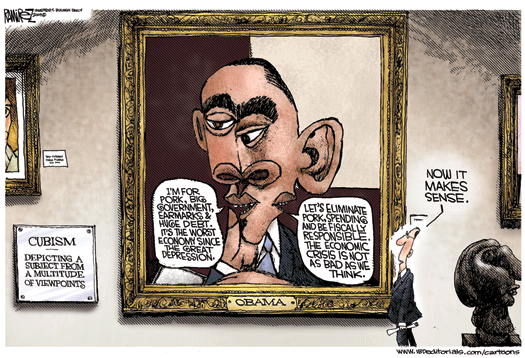
Still, it is quite striking that in the space of a mere 50 days, Obama & Co. have gone from “We are in 1932 and things are getting worse—unless” to “Things are not as bad as we think,” with choruses from the likes of Larry Summers on the dangers of talking down the economy and sowing fear.

That’s Victor Davis Hanson on “one of the most schizophrenic moments in recent memory.”  He asks, “What in the heck is going on?” and suggests three possibilities.

Meanwhile, cartoonist Ramirez has it pictured this way:

Obama Picasso

Rahm E., what a guy! Danny D. too. Whence comes such another?

Say Rahm E. gave a million to his alma matter, which let’s say is NU (it’s not). Fine.  Say he gave $900G to Adler Planetarium.  Philanthropists do that and get good space in local papers. Say he adopts Milwaukee Avenue, as highway signs urge adopting stretches of highway, and coughs up another $8 million.  All of it would be fine. He did it all, in fact, but not with his own money. With other people’s money in his capacity as a Congress Member!

Writing from Oak Park, I must ask, What about our own man in DC, Danny K. Davis, who in 2006 preened himself and was warmly appreciated in a Village Hall town hall-style meeting, in a very expensive suit, bragging (and later being bragged about, I am sure) that he got us $400G to pay for considering capping the Eisenhower?

In DC, that jumbo ATM for the nation, Davis is the man from Illinois-7th, the entire West Side and beyond, for which he goes begging. For FY 2008, the year whence came earmarks in the just-presidentially-signed $410 billion spending bill (budget), Davis requested $3,935,000 as a solo endeavor, of $41,819,000 in all, including joint requests with other Congress members of $37,884,000.

Where else can a guy like him, who never worked at a for-profit job, get that kind of money to spread around — and preen himself on in a town-hall meeting? To be elected to Congress, ah, such a consummation to be wished! Such a bonanza for the public-spirited citizen in expensive suits!

Davis comes by his not-for-profit status honestly, having joined the socialist New Party by September 1998 and received its enthusiastic support. Indeed, he was praised by Democratic Socialists of America as “an old friend of DSA.” So was Obama, for that matter, who also enjoyed DSA support in his 1996 quest for a state senate seat.

But I digress. The point is that Davis can have no problem with earmarks, having lived off public money his whole professional life.