Excellent reaction by Trump, who knows the gloves are off . . .

. . . in the war on his presidency by Democrats.

Before heading off to his so-called “winter White House” in Palm Beach, Florida, on Friday, President Donald Trump summoned some of his senior staff to the Oval Office and went “ballistic,” senior White House sources told ABC News.

The president erupted with anger over the latest slew of news reports connecting Russia with the new administration — specifically the abrupt decision by Attorney General Jeff Sessions to recuse himself from investigations into Russian meddling in the 2016 campaign.

Sources said the president felt Sessions’ recusal was unnecessary and only served to embolden Trump’s political opponents. The attorney general made his announcement Thursday just as Trump returned to Washington from a trip to the U.S.S. Gerald Ford in Virginia for a speech about his agenda as president.

Not your usual Republican timidity.

What I discovered about Wyndham Lewis, George Schuyler, and Roy Campbell

1. Wyndham Lewis: overlooked scourge of mediocrity | Books | The Guardian

According to Lewis, the “era of puff and blurb in place of criticism” started with Arnold Bennett, when he “turned reviewer/star salesman for the publishers”. Lewis portrays Bennett in The Roaring Queen as representative of the commercialisation of literature – the transformation of book-publishing into big business – a business in which Lewis wasn’t about to participate. Hostility to puffery, a proclivity for argument, and brilliant literary insight all boil up in Lewis to explain why he went out of his way to criticise the establishment.

2. A most modern misanthrope: Wyndham Lewis and the pursuit of anti-pathos | Books | The Guardian

From an early age, Lewis cultivated what could be termed anti-pathos: a strategic, rather than merely tactical or opportunist, avoidance of sentiment. This strategy was to manifest itself in his art as a preference for the abstract, in his writing as a preference for satire and invective, and in his politics as a tough-mindedness shading almost imperceptibly into advocacy of tough action.

3. The University Bookman: From Marxist to Black Conservative

Schuyler’s rhetorical extravagances become more understandable when one discovers that he was a mentee of the famed polemicist and cultural critic H. L. Mencken. While there is definitely space for polemicists in cultural criticism, it is important to recall that polemicists have the tendency to sacrifice dialectical argumentation for the attention that comes from exaggerated, performative disagreement. They garner attention but can cheapen important points that are more suited to sober analysis. Polemicists, then, can only be serious thinkers to the extent that they are willing to prioritize serious thought above attention-garnering antics.

4. The University Bookman: Roy Campbell: A Poet for Our Time?

The real reason [Campbell] has been exiled from the discussion for so long and for so thoroughly go back to his time in Britain in the 1920s. He and his wife Mary became involved in the Bloomsbury Group, and Vita Sackville-West seduced her. Campbell and his family moved to the south of France and he proceeded to attack the decadence and dissolution of the Bloomsbury Group in a long satire, The Georgiad (1931), modeled on Alexander Pope’s The Dunciad.

As Roger Scruton wrote in 2009, the Bloomsbury Group’s ideals “amounted, for Campbell, to a refusal to grow up. The new elite, in Campbell’s opinion, lived as bloodless parasites on their social inferiors and moral betters; they jettisoned real responsibilities in favor of utopian fantasies and flattered themselves that their precious sensibilities were signs of moral refinement, rather than the marks of a fastidious narcissism.”

In other words, they were the original fragile snowflakes.

Well.

What I learned about Pelagianism, the go-it-alone heresy

1. Pope: Ancient heresy plagues modern Church

Pelagius . . .  believed that “man could, by the natural power of free will and without the necessary help of God’s grace, lead a morally good life” . . . . Indeed, Pelagius believed that several Old Testament figures, without the help of grace, led sinless lives.

Pelagius held that although Adam offered a bad example, his sin altered only his own relationship with God, and that consequently there is no original sin from which Adam’s descendants need to be redeemed. Pelagius’ followers thus denied that baptism cleanses the soul from original sin and also denied that the sacrament elevates the baptized into a state of supernatural friendship with God. Pelagius did believe that God wished to make it easier for human beings to lead sinless lives, and so God instructed people through the law of Moses and by Christ’s teaching and good example. [period]

Pelagius held, however, that human beings do not need the interior assistance of God’s grace to avoid sin and lead holy lives; instead, he believed that holiness is attained through one’s unaided free will.

2. Pelagianism – Wikipedia

Pelagianism is the belief that original sin did not taint human nature and that mortal will is still capable of choosing good or evil without special divine aid. This theological theory is named after the British monk Pelagius (354–420 or 440), although he denied, at least at some point in his life, many of the doctrines associated with his name. Pelagius was identified as an Irishman by Saint Jerome.[1] Pelagius taught that the human will, as created with its abilities by God, was sufficient to live a sinless life, although he believed that God’s grace assisted every good work. Pelagianism has come to be identified with the view (whether taught by Pelagius or not) that human beings can earn salvation by their own efforts.

3. The False Teachers: Pelagius – Tim Challies [a Protestant view]

Pelagius believed that man had not been entirely corrupted by Adam’s fall and that he could, by his own free will, do works that pleased God, and thus be saved. This led Pelagius to deny the doctrines of original sin and predestination, and to deny the need for special grace to be saved. Essentially, he believed that man is basically good and moral and that even pagans can enter heaven through their virtuous moral actions.

4. Pelagius Lives – Catholicism.org

Pelagius was a rationalist and, consequently, had to confront in his day the same perplexing question confron­ting ours: If all men had indeed inherited original sin, and therefore would suffer the loss of the Beatific Vision unless they embraced the One True Faith and were baptized, what of the vast numbers of men at the ends of the earth who had never heard of Christ? Would it not be unjust of God to send such men to hell?

Etc. etc. etc.

What I discovered yesterday about Illinois — Top school spending, Blacks without jobs, No-bargain taxation, Press-passing oddity, A grass-roots discussion

1. Illinois education funding fight not about kids: Illinois Policy Institute – Opinion – Crain’s Chicago Business

ThinkStock

The fact is Illinois already spends $13,077 per student, more than any other Midwestern state: 37 percent more than Indiana, 32 percent more than Missouri and 17 percent more than Wisconsin.

If critics of education truly wanted more funding for classrooms, they’d push lawmakers to eliminate the many perks that drive up pensions. They’d demand a reduction in the hundreds of overlapping districts and the bureaucracies that run them. And they’d call for moderation in administrator pay.

Instead, they’re demanding more from struggling taxpayers, who already pay the highest property taxes in the nation.

2. Illinois ended 2016 with highest black unemployment rate of any state | Illinois Policy
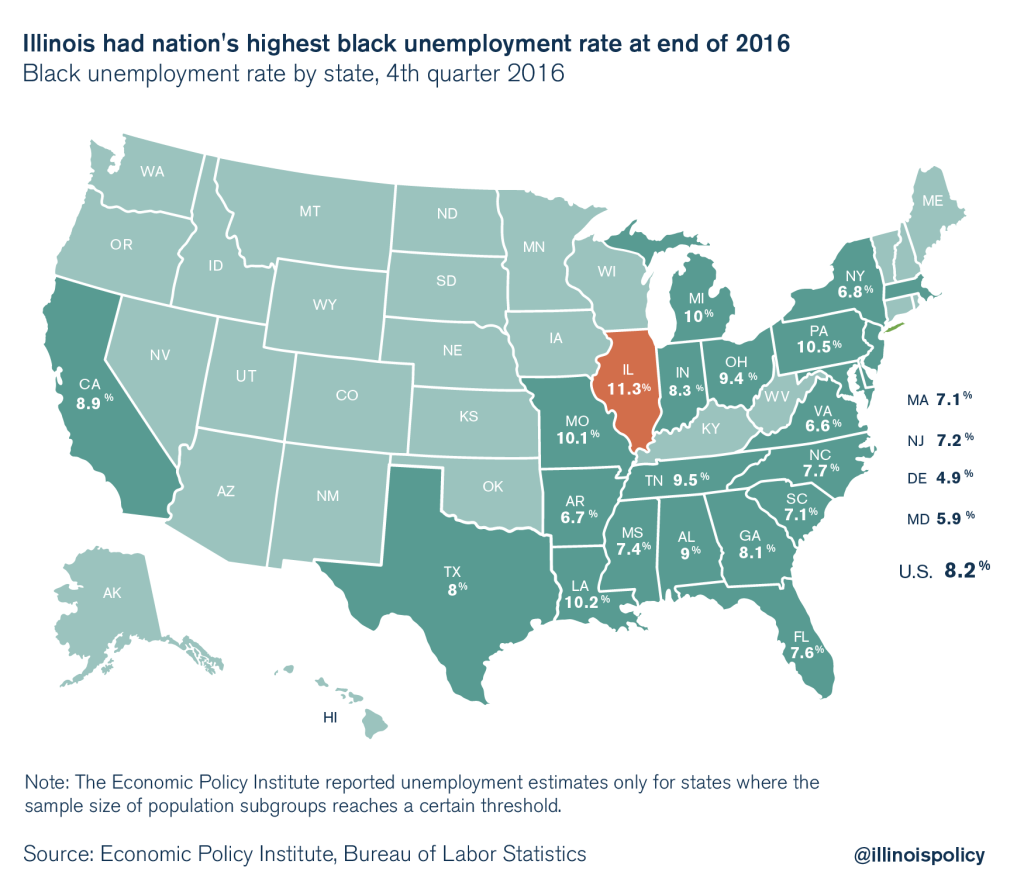
illinois black unempolyment rate


Illinois is still home to the nation’s highest black unemployment rate, according to a new analysis from the Economic Policy Institute, or EPI. Illinois’ black unemployment rate is 11.3 percent, compared with the next highest state, Pennsylvania, at 10.5 percent. The data represent a reduction in the unemployment rate for Illinois, but also serve as a stark reminder that black people have a harder time finding jobs in Illinois than in any other state in the country.

The Land of Lincoln has had the highest black unemployment rate of any state since the second quarter of 2015. Illinois is a low-growth state, especially for industrial occupations, making it difficult for workers to find rewarding jobs in the local economy.

3. 10 reasons Illinois’ ‘grand bargain’ fails taxpayers | Illinois Policy 

A recent poll by Anzalone Liszt Grove Research says 66 percent of Illinoisans oppose income tax increases. Nearly 50 percent strongly oppose such tax hikes.

That’s not only because Illinoisans can’t afford another tax hike; it’s also because taxpayers know tax hikes won’t work. Illinois took in an additional $31 billion over the course of the 2011 income tax hike. Politicians claimed this money would be used to pay down the state’s pension debt and unpaid bills and solve the state’s fiscal crisis. In 2011, Illinois’ unpaid bills totaled $8.5 billion – today, the state has more than $12 billion in unpaid bills. In 2011, Illinois’ unfunded pension debt was $82.9 billion. Today, it’s more than $130 billion

4. Journalists Demand Access, but Sometimes They’re Selective – WSJ

The White House press corps, Feb. 16.

The national press was outraged after reporters from CNN, the New York Times, Politico, BuzzFeed and the Los Angeles Times were kept out of an off-camera White House press briefing last week. . . . . Their concerns are valid: Government officials can silence critics by picking and choosing who gets access. But few have noted that the Trump administration’s actions are far from unprecedented. . . . . A prime example comes from Illinois. As an attorney for the Liberty Justice Center, I represented a veteran journalist who was denied statehouse press credentials in Springfield.

Scott Reeder . . .  spent the first 20 years of his career at newspapers in Texas, Nevada and Illinois, racking up journalism awards along the way. He became a well-known fixture in the Illinois Capitol. Then he decided to start a statehouse news service to keep doing the same work he had always done. Joining with the Illinois Policy Institute, a government watchdog organization, Mr. Reeder planned to launch his new venture in 2013.

But when he applied for statehouse press credentials, Mr. Reeder got the cold shoulder from lawmakers who decide which outlets can cover them. Mr. Reeder was a tough reporter, ruffling feathers of politicians on both sides of the aisle—as journalists should—and his application was denied because of his association with the institute.

Officials determined that under the legislature’s rules Mr. Reeder was no longer entitled to a pass because the institute was registered as a lobbyist and wasn’t “primarily” engaged in news reporting. . . .  [But] the Chicago Tribune had no trouble getting credentials when its then-owner, the Tribune Co., hired a firm to lobby on its behalf and operated businesses unrelated to news, such as the Chicago Cubs. . . . .

As for Mr. Reeder, he got little support from fellow reporters. Some even published articles attempting to delegitimize his work because he was no longer employed by a legacy media outlet.  . . . .

Here’s to hoping the media will continue to advocate equal access, just as forcefully as they are now [in the recent Trump administration controversy], for journalists of all stripes covering all levels of government.

Illinois Blues: How the Ruling Party Talks to Voters Kindle Edition

From a discussion of school matters by a panel of state legislators and a parent committee, at Oak Park’s Percy Julian middle school, Oct. 9, 2013, in Chapter 8, “Legislators go to school”:

What the pope said on Ash Wednesday: Creation care, Salvation by works, Ideological faith, Curing sin-suffocation

Blithe Spirit

1. Pope: learn from indigenous peoples how to care for creation – Vatican Radio
A Munduruku on the Tapajos river in Parà State, Brazil - ANSA

It is necessary, he said, to learn from these peoples how to relate to nature in the quest for a sustainable model “that can be a valid alternative to the race for profit that exhausts natural resources and damages the dignity of peoples”.

2.The Pope on salvation by works

Pope_Francis_Korea_Haemi_Castle_19_(cropped)

Catholics, Protestants often say, believe in salvation by good works.  This engenders the reply from thoughtful Catholics, no we don’t!  You have to have grace.  In fact, we even believe in justification by faith, just like you Lutherans do, as proven by the accord we signed with liberal Lutherans.  Since there is now no real disagreement, there is no need for the Reformation divisions.  You can come back to Rome and enjoy being under Pope Francis.

But Pope Francis keeps preaching that salvation is, in fact…

View original post 251 more words

What the pope said on Ash Wednesday: Creation care, Salvation by works, Ideological faith, Curing sin-suffocation

1. Pope: learn from indigenous peoples how to care for creation – Vatican Radio
A Munduruku on the Tapajos river in Parà State, Brazil - ANSA

It is necessary, he said, to learn from these peoples how to relate to nature in the quest for a sustainable model “that can be a valid alternative to the race for profit that exhausts natural resources and damages the dignity of peoples”.

2. The Pope on salvation by works

Pope_Francis_Korea_Haemi_Castle_19_(cropped)

Catholics, Protestants often say, believe in salvation by good works.  This engenders the reply from thoughtful Catholics, no we don’t!  You have to have grace.  In fact, we even believe in justification by faith, just like you Lutherans do, as proven by the accord we signed with liberal Lutherans.  Since there is now no real disagreement, there is no need for the Reformation divisions.  You can come back to Rome and enjoy being under Pope Francis.

But Pope Francis keeps preaching that salvation is, in fact, by good works.  He is reported to have said recently that it’s better to be an atheist than a bad Christian.  Now this is not exactly what he said, according to ChurchPop; in context he was referring to Christians living a “double life” of sin and piety, which creates a “scandal” that makes outsiders think it would be better to be an atheist.  But read his sermon yourself to get a sense of where he stands on the importance of good works for salvation.  Note how he warns against “excessive confidence” in Christ’s forgiveness.

3. Pope: Ideological faith adores a ‘disincarnate’ god – Vatican Radio

Pope Francis delivers the homily at the morning Mass at the Casa Santa Marta on Thursday.

(Vatican Radio) The compass of the Christian directs him to follow Christ crucified, not a disincarnate god, but God made flesh, Who bears in Himself the wounds of our brothers. That was the message of Pope Francis at the morning Mass at the Casa Santa Marta on Thursday.

4. Pope on Ash Wednesday: Feeling suffocated by sin? Let God save you

Pope on Ash Wednesday: Feeling suffocated by sin? Let God save you

ROME – At Ash Wednesday Mass, Pope Francis spoke about the bad habits, negativity, and sin present in our lives which cause us to be choked off from the life-giving breath of God – supernatural grace.

“The breath of God’s life saves us from this asphyxia that dampens our faith, cools our charity and strangles every hope,” he said March 1. “To experience Lent is to yearn for this breath of life that our Father unceasingly offers us amid the mire of our history.”

When Black Caucus brothers and sisters betray their brothers and sisters

Livin’ high on the hog:

The Congressional Black Caucus PAC (CBC PAC) spends lavishly on upscale resorts and hotels, catering at exclusive restaurants, and on fundraising and Broadway tickets, according to a review of campaign finance records.

The CBC PAC, which is the fundraising arm of the Congressional Black Caucus, puts far more money towards administrative and fundraising purposes than it donates to candidates, the intended purpose of the political action committee.

Bad, bad, bad.

What I looked up yesterday: How are Trump and Pope Francis alike?

What Donald Trump and Pope Francis actually have in common

(a year ago):

 Both are outsiders bent on shaking up their establishments. . . . There are rhetorical similarities too. . . .   Trump addresses potential voters in a vivid and snappy way, using simple words and arresting statements. Much the same could be said of Francis.. . .  both know how to make headlines. . . .  And both men promise to empower those who feel excluded  . . .  Francis and Trump prioritize an iconoclastic style over substance — or coherence.  The basis of their appeal is a mistrust of institutions, which is widespread and increasing.  . . .

Etc.

What Trump and Francis have in common  (two weeks post-election):

[Both] have a fondness for . . .  name-calling that’s rare among presidential candidates and popes. . . .  Trump calls people ‘‘low energy’’, ‘‘liar’’ and ‘‘loser’’, while Francis prefers ‘‘Pharisee’’ and ‘‘self-absorbed Promethean neo-Pelagian’’ (though he’s not above ‘‘whiner’’ and ‘‘sourpuss’’ as well).

But their . . . language reflects a shared mastery of the contemporary media environment, in which controversy and unpredictability are the great currencies, and having people constantly asking “Did he really just say that?” is the surest ticket to the world’s attention.”

Pope Francis does not use theological terms in their traditional meanings, so he has to be understood in a different way. When the Holy Father uses “grace”, “conscience”, “absolute” or “heresy”, he does not mean what the theological tradition means by them.

He quotes another writer:

 “When [Trump] makes [exorbitant] claims . . . the press takes him literally, but not seriously, but his supporters take him seriously, but not literally.”  . . . .  [Catholics, on the other hand] take the Holy Father both seriously and literally . . . [and] are not used to taking the pope seriously but not literally.

Etc.

How Are Pope Francis & Donald Trump Alike? (five days later):

[Trump is] redefining almost every day what we can expect from a president, but also putting at risk some fundamental assumptions about American political life and the way a president behaves.  . . . .

Pope Francis does this when in his letter on married life, “Amoris Laetitia,” he employs “indirectness” where Catholics expect “formal words” that are “supposed to be supernaturally preserved from error” — not “winks and implications,” a NY Times columnist wrote acerbically.

A commenter got this writer’s approval as “insightful.”

Both [Trump and the Pope] are dramatic and emotional, not intellectual: we are used to thoughtful and intellectually solid even — if you disagree — justifications from conservatives and popes and you are not going to get that from either.

Lots more from this writer, for whom both Trump and Pope Francis are thoroughly objectionable.