your mask ennobles me. public health as pretext for hierarchical validation

Have a look at this candidate for the last word on mask-o-mania, and never mind the hostility to upper case:

of all the utterly discredited non-pharmaceutical interventions around covid, perhaps none stands as pervasive in its application and as universal in its failure as masks.

it was a flat out cargo cult belief set from the beginning and the inefficacy of this purported intervention was known and knowable beforehand and was confirmed, again and again, by all the emerging data.

the studies undertaken to “prove” efficacy were shams, lacked control groups, used cherry picked data, fraud, and methodologies so hilariously bad as to call into question the basic competence and honesty of those pushing them. the CDC has been a disgrace.

and yet the intensity of the push for this meaningless mitigation ratcheted ever upward. a certain class of person loved this, demanded this, needed this. no data could dissuade their desire.

even those who gathered the data that proved so helpful in proving this such as emily oster backed away from their own output because it so clearly contradicted the narrative of their tribe. she, an ivy league economics professor, disavowed her own discovery and flipped to team emotion. (another dark day for the gato alma mater)

it was sad to see, but altogether predictable.

masks are signs of subjugation. they dehumanize. they alienate. and this is WHY they are so attractive to so many.

this is why forcing them on kids to dominate them and force them into compliance with state over self or even parents is such a high priority goal for those that have collectivist plans for their futures. it establishes precisely who is in charge.

masks are not about public health.

masks are about hierarchy.

they not only represent a high visibility in-group/out-group tribal marker, but they have wonderous potential as a form of separating the powerful from the powerless, the nobles from the commoners, the dictators from the dictated to.

it has become the opiate of the classes. . . .

more more more . . .

From the marvelous Substack columns of bad cattitude.
A week to which there is no return

Maiden voyage, 12/1/21:

Man with coffee, seated, looking around . . . 3:30 in the p.m. on Colectivo patio, a few yards from Clark Street reading Richard Hughes’ Fox in the Attic. Very careful writer, says intro, author who takes time to do it right. It shows.

Lo, on Clark and the side street Rascher, where the man sits, mad monks walk by. Mad monks — he’s never met one, it’s a Gothic trope — are his fellow citizens in masks, covered nose to gullet, one after another, heads down, avoiding so much as a glance at this man in snappy red sweater under stylish green, chilly-weather vest.

They walk quickly as if he were emitting darts of sickness. They remind the man that these are the days of the virus, the evil spirit which hovers over all.

To dentist today . . . He had my “partial” ready to try. . . .

more more more . . . 

Coming up: Love-your-enemy Sunday . . .

Dominus Vobiscum: Notes from a massgoer's underground

Aka Seventh Sunday in Ordinary Time, where we have in Luke’s Gospel, Jesus talking:

“To you I say,
love your enemies, do good to those who hate you,
bless those who curse you, pray for those who mistreat you.

Another hard saying from the Lord and Master. We groan at it. He sees the reluctance and asks, “Will you also go away?”

To which our bewildered, self-serving, self-correcting, “Lord, to whom shall we go? Thou hast the words of eternal life.”

That so? Not so sure, we add, “I believe, Lord, help thou my unbelief.” The best we can do at the moment.

He seizes the moment: “Thy faith hath saved thee. Go thou and sin no more.”

The whole package. We walk away like the speedster who just stole second, index finger pointing up.

View original post

Pope Francis’ way of governance: Crafty, unpredictable, keeping possible enemies off balance

As described by veteran Vatican analyst Andrea Gagliarducci in his VaticanMonday  blog:

Pope Francis’ communication is centered on himself. The Pope’s interviews are about what the Pope thinks, and what he corroborates with pieces of Church history. The other popes’ starting point was the Church, always taking a step back from the role they held. Even with John Paul II, despite his evident charisma gathering crowds.

Pope Francis’ was, therefore, a change of epoch. In addition to [how he has] kept his distance from problems, there are some contradictions . . .

Vatican expert Sandro Magister has noted a disparity of treatment, for example, in three particular circumstances: the question of the Order of Malta; how the Community of Sant’Egidio is treated; and the expulsion from the community of Bose of his founder, Brother Enzo Bianchi, who was also considered a friend of Pope Francis, and whom the Pope had wanted at the Synods on the family.

These . . .  examples show that there are no people whom the Pope always considers friends. Even the personal secretaries of Pope Francis have changed throughout the pontificate. This is because Pope Francis wants to manage everything personally. His strategy is to take power away from others. And so, no one has control.

The particular secretaries do not have it, destined to be replaced and in any case unaware of the Pope’s many appointments. The dicastery heads do not have it, uncertain about the Pope’s decisions, and destined not to remain for more than two five-year terms. Not even the local bishops have it, forced to navigate precariously, hoping not to make serious mistakes.

See more here . . . 


Heaven can wait, we hear . . .

Dominus Vobiscum: Notes from a massgoer's underground

Not my call anyway. But can’t wait for heaven? Now you’re talkin’. Very important Christian thought that is.

Purgatory part of the deal, yes, offering a goad to good performance and not to be dismissed. But we need more than a goad, which is where heaven comes in? I think so.

In motivational terms, we’re talking about here. High praise for something to say it works for us, no? Yes.

So let’s not forget the joy to come when, cleaned up for the experience (purged), we cash in, if you pardon the earthy expression.

In omnibus respice finem, Fr. Kemper, young Jesuits’ spiritual father in olden days, used to say. Consider the end whatever you’re doing.

Or as the young Jesuit John Berchmans made his motto centuries before, Quid hoc ad aeternitatem? How does this make sense — whatever you’re doing — in view of the afterlife?

View original post

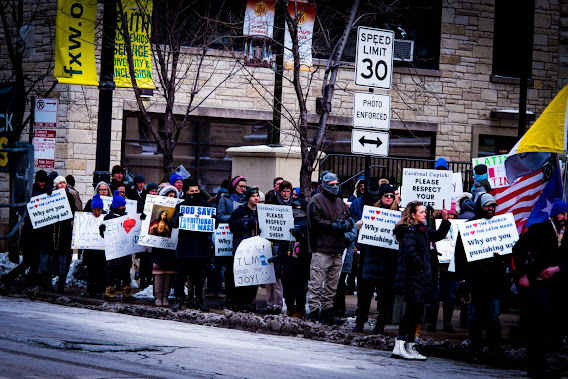
So It Begins: Chicago’s Fight for the Mass of the Ages

In case you missed this. Nothing in Trib or Sun-Times, however.

Bagpipes sounded on State Street, and a truck with flashing images of the Mass of the Ages rolled by. We stood shoulder to shoulder or knelt on the sidewalk and prayed the Rosary with Holy Name Cathedral looming large behind us. Men held signs aloft for the traffic to read: “Cardinal Cupich: Why are you punishing faithful Catholics?” It was the First Sunday of February.

And the citizens were restless.

Over two hundred of us gathered there. Men, women, even a few children (bundled up well against the cold). There were Chicago’s quintessential old Polish ladies in fur coats, and old men too, but the majority were millennials and gen-Zers. A mom in her third trimester walked about with an iPhone filming the livestream. A thirty-something dad led us through fifteen decades of the Rosary, interspersing the mysteries with hymns and other traditional devotions.

Indeed.

Some car horns honked, but whether friendly or hostile I couldn’t tell. Shouts rang from a passing driver or two, but they were lost in the Chicago wind. When the Cathedral’s 10:30 a.m. Mass ended and its participants picked their way through our ranks, looking embarrassed and saying nothing, I realized with a pang how Traditiones Custodes has already begun to rip apart the flock.

Not to mention the dutiful concurrence of His Eminence the archbishop.

But despite this sorrow, a spirit of joyful calm prevailed over us—joyful because we recognized the honor that was ours in taking up this cause, and calm because, well, perhaps many of us are getting rather used to this kind of thing. We have prayed in the same way in front of abortion facilities, in front of businesses with draconian mandates, in front of statues of saints threatened by raving mobs, and in front of our own churches with doors locked and barred. [In a previous assignment, then-Bishop Cupich did literally lock a church’s doors to prevent Traditional Latin services.] Now the doors are open but in a strange conditional way. All are welcome but those who love the Mass of the Ages. Hence the question—purely rhetorical—for His Eminence Cardinal Cupich.

more more more here . . . including:

The next Rosary Rally will take place Sunday, March 6th at 11AM once again outside of Holy Name Cathedral. See you there! For more details, visit the event’s Facebook page.

Vaccine Passports Don’t Work But Should Be Adopted Anyway to Coerce Young People into Being Vaccinated, Scientific Advisers Tell British Government

Tut, tut:

Vaccine passports do little to stop coronavirus transmission at festivals, but should still be considered anyway to increase vaccine uptake in young people, scientists advising the Government have said. It’s the first time advisers have admitted the vaccines do not prevent transmission but have argued the illiberal policy should be adopted purely to coerce people to do something for their own benefit. The Telegraph has the story.

So. Cat’s out of bag. The little foolers.