Control, control. Use that crisis. Never know when a better is coming. Go Dems!!
Category: Blithe Spirit
The good and the bad, emphasis on Trib and Sun-Times
How words of wisdom should sound . . .
. . . or how they shouldn’t, for best effect:
Words of wisdom needn’t sound portentous, like the narration in a biblical epic from the 1950’s. That tone is likely to sound parodic to contemporary ears. Better to keep it serious but colloquial, or even amusing and colloquial. Or at least homely, heavy on one- and two-syllable words, and avoid the high-falutin’ boilerplate. Don’t try to sound wise, which is never wise. With that in mind, you’ll find wisdom in unexpected places.
Catholic U.S. has a leader. Archbishop Cordileone calls up for us an anti-segregation predecessor, delivers stirring defense of church moving hard on Catholic officials
In his column “Our duty to challenge Catholic politicians who support abortion rights” in the Washington Post, he uses a major platform in the heart of pro-abort support:
Prominent politicians lost no time in reacting hyperbolically to the Supreme Court’s decision refusing to enjoin Texas’s new law banning abortions after the detection of a fetal heartbeat. President Biden announced a “whole-of-government effort” to find ways to overcome the Texas measure.
House Speaker Nancy Pelosi (D-Calif.) denounced the Supreme Court’s refusal as a “cowardly, dark-of-night decision to uphold a flagrantly unconstitutional assault on women’s rights and health,” and promised new legal action: “This ban necessitates codifying Roe v. Wade” in federal law.
He focuses:
As a faith leader in the Catholic community, I find it especially disturbing that so many of the politicians on the wrong side of the preeminent human rights issue of our time are self-professed Catholics. This is a perennial challenge for bishops in the United States: This summer, we provoked an uproar by discussing whether public officials who support abortion should receive the sacrament of the Eucharist. We were accused of inappropriately injecting religion into politics, of butting in where we didn’t belong.
Many Catholics have long been awaiting such an articulate, direct reaction to the pro-abort.
I see matters differently. When considering what duties Catholic bishops have with respect to prominent laymen in public life who openly oppose church teachings on abortion, I look to this country’s last great human rights movement — still within my living memory — for inspiration on how we should respond.
The example of New Orleans Archbishop Joseph Rummel, who courageously confronted the evils of racism, is one that I especially admire. Rummel did not “stay in his lane.” Unlike several other bishops throughout this country’s history, he did not prioritize keeping parishioners and the public happy above advancing racial justice. Instead, he began a long, patient campaign of moral suasion to change the opinions of pro-segregation White Catholics.
Specifically:
In 1948, he admitted two Black students to New Orleans’s Notre Dame Seminary. In 1951, he ordered the removal of “white” and “colored” signs from Catholic churches in the archdiocese. In a 1953 pastoral letter, he ordered an end to segregation throughout the archdiocese of New Orleans, telling White Catholics that, because their “Colored Catholic brethren share … the same spiritual life and destiny,” there could be “no further discrimination or segregation in the pews, at the Communion rail, at the confessional and in parish meetings.”
In 1955,
Rummel closed a church for refusing to accept a Black priest. In a 1956 pastoral letter, he declared:“Racial segregation as such is morally wrong and sinful because it is a denial of the unity and solidarity of the human race as conceived by God in the creation of Adam and Eve.” On March 27, 1962, Rummel formally announced the end of segregation in the New Orleans Catholic schools.
He responded to furious opposition.
Many White Catholics were furious at this disruption of the long-entrenched segregationist status quo. They staged protests and boycotts. Rummel patiently sent letters urging a conversion of heart, but he was also willing to threaten opponents of desegregation with excommunication.
On April 16, 1962, he followed through, excommunicating a former judge, a well-known writer and a segregationist community organizer. Two of the three later repented and died Catholics in good standing.
. . . Was that weaponizing the Eucharist? No. Rummel recognized that prominent, high-profile public advocacy for racism was scandalous: It violated core Catholic teachings and basic principles of justice, and also led others to sin.
More more more on the why and wherefore, then his close:
You cannot be a good Catholic and support expanding a government-approved right to kill innocent human beings. The answer to crisis pregnancies is not violence but love, for both mother and child.
This is hardly inappropriate for a pastor to say. If anything, Catholic political leaders’ response to the situation in Texas highlights the need for us to say it all the louder.
The archbishop has had his say.
Doing for Noonan what has to be done
Long history of Peggy’s being for this before she was against it, or him or her, making turncoat look like steady at the wheel. Her finger in the wind isn’t even good at seeing at how it blows, but like Peter Pan she won’t give up, she’ll never give up . . .
How we pray “shapes what we believe”
New ritual (“new mass” since Vatican 2) vs. old:
For Catholics, how we pray shapes what we believe. The old ritual physically aims us toward an altar and tabernacle. In that way it points us to the cross and to heaven as the ultimate horizon of man’s existence. By doing so, it shows that God graciously loves us and redeems us despite our sins. . . .
The new ritual points us toward a bare table, and it consistently posits the unity of humankind as the ultimate horizon of our existence. In the new Mass, God owes man salvation, because of the innate dignity of humanity. Where there was faith, now presumption. Where there was love,now mere affirmation, which is indistinguishable from indifference. It inspires weightless ditties like “Gather Us In.” Let’s sing about us!
Hard words, from Pope Francis Is Tearing the Catholic Church Apart in NY Times . . .
Fetus-execution business takes a hit in Texas
Dating app businesses scramble to save the day.
Two Texas-based dating app companies have created funds to pay for abortions for women seeking to end the life of their unborn children after the Supreme Court declined to block the state’s pro-life fetal heartbeat law.
The Texas law, Senate Bill 8, went into effect on Tuesday after the high court declined to take emergency action to block it. On Wednesday, the Supreme Court justices voted 5-4 to allow the law to remain in effect. The law bans abortions after six weeks of pregnancy, the time at which an unborn child has developed a heartbeat.
Abortion advocates opposing the law complain that most women might not even know they’re pregnant at six weeks. They say Texas has effectively banned abortions within the state and done so unconstitutionally, based on Roe v. Wade‘s precedent.
Panic on Abortion Drive.
Afghanistan debacle: Triumph of the Left
90 Retired Generals Pen Scathing Letter Calling For Austin And Milley To Resign Immediately
“The retired Flag Officers signing this letter are calling for the resignation and retirement of the Secretary of Defense (SECDEF) and the Chairman of the Joint Chiefs of Staff (CJCS) based on negligence in performing their duties primarily involving events surrounding the disastrous withdrawal from Afghanistan,” reads a Monday letter signed by 90 retired top-ranking military officials.
“As principal military advisors to the CINC (Commander in Chief)/President, the SECDEF and CJCS should have recommended against this dangerous withdrawal in the strongest possible terms,” they wrote.
“If they did not do everything within their authority to stop the hasty withdrawal, they should resign.”
Horrifying aftermath:
“The consequences of this disaster are enormous and will reverberate for decades beginning with the safety of Americans and Afghans who are unable to move safely to evacuation points; therefore, being de facto hostages of the Taliban at this time. The death and torture of Afghans has already begun and will result in a human tragedy of major proportions. The loss of billions of dollars in advanced military equipment and supplies falling into the hands of our enemies is catastrophic. The damage to the reputation of the United States is indescribable. We are now seen, and will be seen for many years, as an unreliable partner in any multinational agreement or operation. Trust in the United States is irreparably damaged.
Moreover, now our adversaries are emboldened to move against America due to the weakness displayed in Afghanistan. China benefits the most followed by Russia, Pakistan, Iran, North Korea and others. Terrorists around the world are emboldened and able to pass freely into our country through our open border with Mexico.”
It’s a Democrat thing.
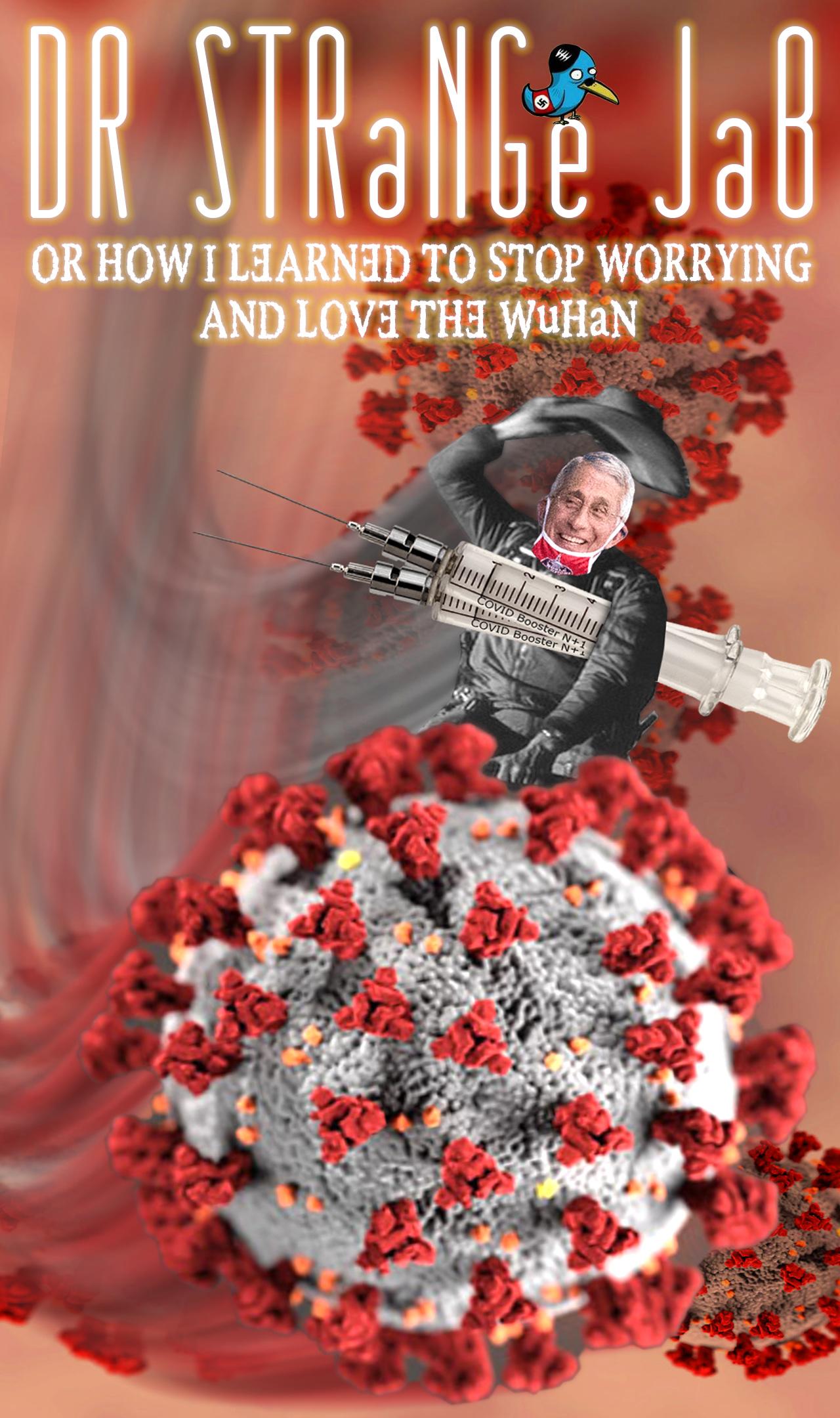
How about a little fun at the Fauci man?
Governor Pritzker Must Answer Justice Kavanaugh’s Questions On Eviction Bans – Wirepoints
Nothing in Gov. JB Pritzker’s emergency orders on COVID is more egregiously unjust, tyrannical and arbitrary than his moratorium on residential evictions. Pritzker, in his sole discretion, has effectively forced landlords alone to pay the cost of a free housing program. It’s that simple. His eviction ban prevents even mom and pop landlords from collecting rent they need to pay their mortgages and property taxes, and often to provide income they live on.
The United States Supreme Court last week struck down a federal moratorium on residential evictions. The ruling was based on the absence any authorization for the moratorium by Congress, not on broader constitutional issues like property rights, contract rights or due process. Therefore, as a strict legal matter, the ruling does not apply to Pritzker’s own eviction moratorium. It’s based on Pritzker’s emergency powers, as he sees things.
So Pritzker has been free to extend his emergency order again, as he did last week. And he will probably do so for an indefinite period of time. With COVID breaking through vaccinations at a much faster pace than originally hoped, it’s clear that COVID will be with us indefinitely. That means Pritzker will claim his authoritarian emergency power also extends indefinitely.
But with just a few short questions in his written concurrence with last week’s ruling, Justice Brett Kavanaugh showed why eviction bans at any level, from any perspective, are so crassly dictatorial and irrational. If the Centers for Disease Control can, through a federal eviction ban, force landlords the pay for free housing, what can’t they do? Here’s how Kavanaugh put it:
Could the CDC, for example, mandate free grocery delivery
to the homes of the sick or vulnerable?
Require manufacturers to provide free computers to enable people to work
from home?
Order telecommunications companies to provide free high-speed Internet service to facilitate remote work?
Yes, they could – if you accept the absurd thinking behind eviction bans. Pritzker likewise could do the same things at the state level – and dictate countless similar actions – if you accept that thinking behind eviction bans.
Devastating analysis of the Biden pullout from Afghanistan
The Character of Nations and Failed Leadership
Perhaps not since 1939, when this nation turned away over 900 German Jews seeking refuge from Nazi terror and certain death, has an American president acted as shamelessly as we approach President Biden’s unilateral deadline for evacuating our Afghan allies.
The jewel in the crown of Biden’s career.
 Blithe Spirit